… they were troubled and abandoned, like sheep without a shepherd.
This morning’s Gospel Reading bears imagery that foreshadows Lent, the Sacred Triduum, and Eastertide. Catholics instinctually understand that Advent prepares Christians for Christmastide, and that Lent prepares them for Eastertide. Less understood is that Advent and Christmastide, considered as a single block of time, prepares Christians for Lent and Eastertide.
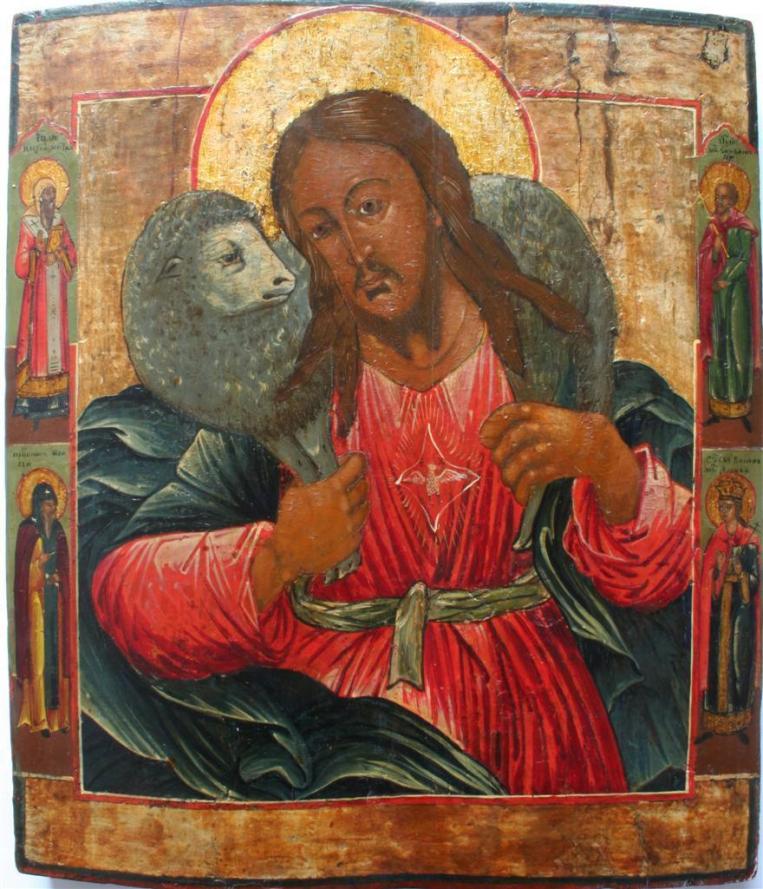
The evangelist tells us that the crowds were “like sheep without a shepherd”. Jesus, of course, is the Good Shepherd [see John 10:11,14]. His noblest act of shepherding took place on Calvary, when He sacrificed His life for His flock.
Jesus’ vocation of Self-sacrifice on Calvary is the chief reason why God the Father sent His Only-Begotten to earth. It’s important not to lose sight of this during Advent and Christmastide. God the Father sent His Son to be both shepherd and sheep. Indeed, He shepherds us by becoming one of the sheep: by being born as one of us, so that on the Cross He could offer to the Father the sacred humanity He received from the Blessed Virgin Mary.
Advent corresponds roughly with the final weeks when the day grows shorter (at least, in the Northern Hemisphere). There’s a great deal of imagery in the scriptures and liturgies of Advent that relates to the human struggle with darkness. For example, the feast day of Saint Lucy—whose name comes from the Latin word for light, and whose feast is celebrated in many countries with a brilliant display of candles—falls close to the midpoint of Advent. On the following day the Church celebrates the feast of St. John of the Cross, a Doctor of the Church whose writings explore the “dark night of the soul”.
The refrain to today’s Responsorial is: “The Lord is my light and my salvation.” To reflect upon the Lord God Himself as “light” is infinitely more significant than reflecting upon the earth’s annual descent into darkness, or even upon the human darkness that one experiences while undergoing spiritual purification and growth in the divine virtue of faith.
The notion of the Lord God as light transcends any other notion of light that human persons experience. One way to appreciate this difference is to notice how Psalm 27 continues its description of the Lord. This Lord whom the Psalmist has just described as “light” is the object of the Psalmist’s sight. Consider how unusual that is.
In ordinary human life, light serves to illuminate physical objects. A man would be thought odd if he stared at a light bulb, and reckless if he stared at the sun. But in Psalm 27 the Psalmist describes the Lord as the focus of his sight: “One thing I ask of the Lord; / this I seek: / To dwell in the house of the Lord / all the days of my life, / That I may gaze on the loveliness of the Lord / and contemplate his temple.” One might consider these verses as the Old Testament’s clearest description of what the Church calls the “Beatific Vision”. To be a saint in Heaven is to gaze forever at the Lord, who is pure light.
CCC 522, 711-716, 722: the prophets and the expectation of the Messiah CCC 523, 717-720: the mission of John the Baptist CCC 1042-1050: a new heaven and a new earth
+ + +
Baskin-Robbins used to advertise that they sold 31 flavors of ice cream. You could have a different flavor every day of the month! On the Baskin-Robbins website, the company states that since 1945, they’ve produced over one thousand, three hundred flavors. It’s difficult to imagine that ice cream could come in that many different forms.
During the Season of Advent, one of the virtues that the Church sets before us—both for us to reflect upon, and for us to put into action—is the virtue of humility. One of the potholes that we might fall into, however, is thinking that there’s only one form of humility: that humility looks the same within each person. It doesn’t!
The Season of Advent sets before us several models of humility. During your daily time for prayer and reflection, you might over the next few weeks consider each of these models of humility, one at a time. Each can help you meditate upon what changes you could make in your life in order to make your life look more like the lives of these models of humility.
Who are these models of humility? The four chief models of Advent humility are: St. John the Baptist, St. Joseph, the Blessed Virgin Mary, and Our Lord and Savior Jesus Christ. Obviously that order is in order of increasing humility. Yet the first of the four is first for another reason, also: because we have to begin with the example of St. John the Baptist.
+ + +
Today’s Gospel Reading focuses upon John the Baptist. This passage is the first eight verses of St. Mark’s account of the Gospel. It’s telling that St. Mark chose John the Baptist to be the first person he describes in his Gospel account. St. Mark describes John first, not Jesus, because we need John’s message in order to receive Jesus.
The message of John the Baptist is founded upon humility. Everything about John speaks to humility: from the place where he dwells—a desert—to his clothing—camel’s hair and a leather belt—to his diet of locusts and wild honey. But John’s message is even humbler than his dwelling, clothing, and diet. His message demands that those listening make themselves humble.
John’s message is a “baptism of repentance for the forgiveness of sins.” St. Mark the Evangelist goes on to describe this further: how people “were going out to [John the Baptist] and were being baptized by him in the Jordan River as they acknowledged their sins.”
This act of humility—acknowledging one’s sins—is the first step to accepting the gift of Jesus. Every year about this time, you hear the saying that Jesus is “the reason for the season”. True enough. But what’s the further reason? That is to ask: why was Jesus born in Bethlehem? Why did God the Father send His only Child from Heaven down to earth?
Did God the Father send His Son to earth in order to teach? There are many world religions that recognize Jesus as a great teacher: on a par with other religious teachers such as Buddha, or Mohammed, or Confucius, they claim. But God the Father did not need to send His Son from Heaven in order to teach mankind. He’d been doing that for centuries through the prophets of the Old Testament. God the Father could have dropped down copies of the Sermon on Mount from Heaven if He had wanted to. Teaching was not the chief reason for God the Son to be born at Bethlehem.
The chief reason is summed up in a little saying: “The wood of the crib is the wood of the cross.” Or there’s another saying that expresses the same insight: “Jesus was born in Bethlehem so that he could die on Calvary.” “So that he could die.” What God the Son, as God, could not accomplish from Heaven is to die in order to wash away both your sins, and the punishment that your sins merit. That’s why if you won’t acknowledge your sins as St. John the Baptist demands, you won’t be able to accept Jesus as the gift that God the Father sent Him to be for you.
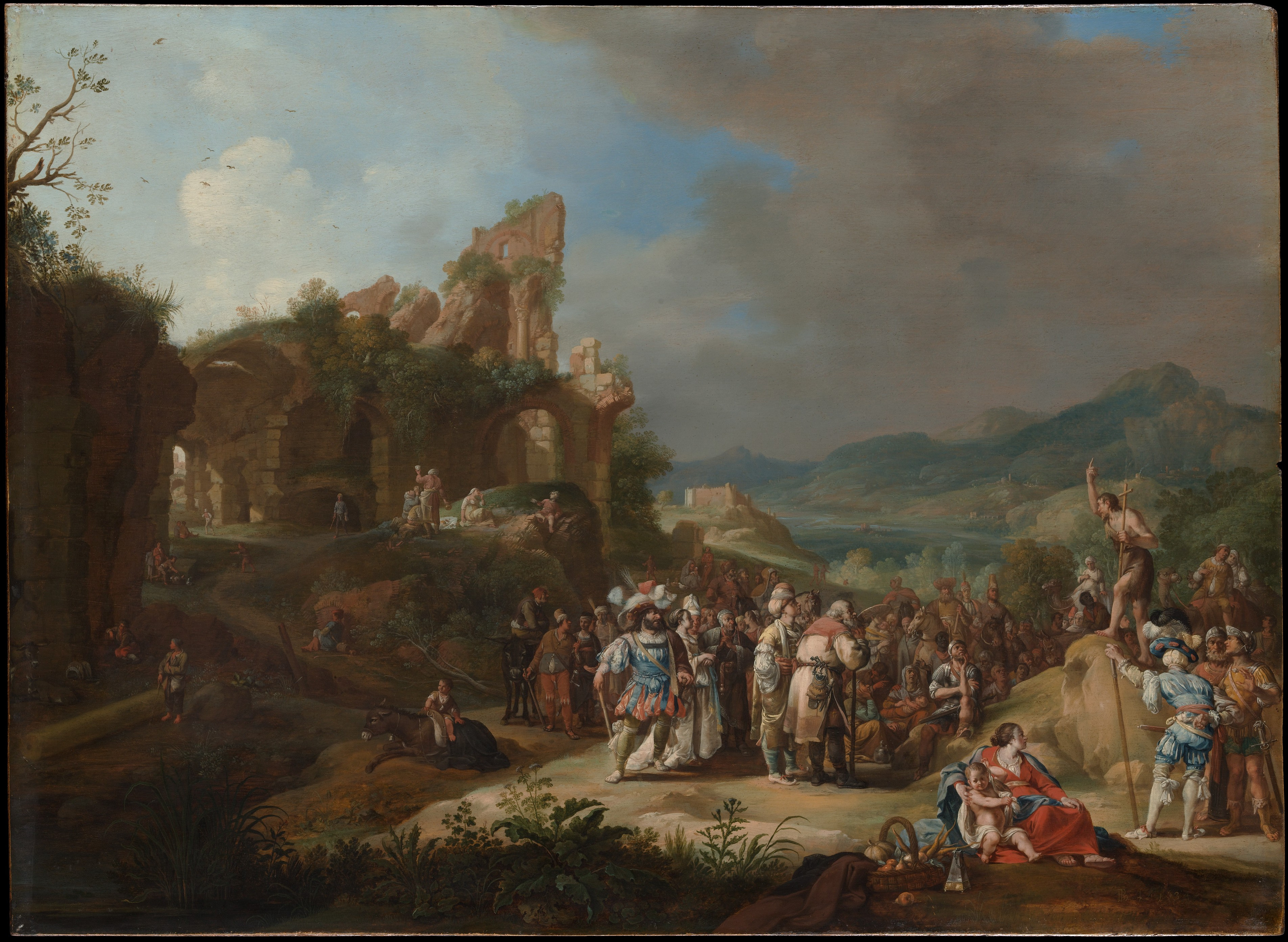
The Preaching of John the Baptist by Bartholomeus Breenbergh (1598-1657)
“… only the one who does the will of my Father ….”
The Apostle Paul is sometimes quoted in order to create a false division between faith and good works. St. Paul makes clear—so it’s said—that salvation in Christ is based upon faith alone. Good works play no role—so it’s said—in reaching salvation.
Against such misappropriation of St. Paul’s words we have the explanation of Jesus in today’s Gospel Reading. “Not everyone who says to me, ‘Lord, Lord,’ will enter the Kingdom of heaven, but only the one who does the will of my Father in heaven.” Should we take Jesus’ reference to someone saying, “Lord, Lord” and equate it with faith, which some say alone bears salvation? One might argue that point, and it’s a point worth debating.
However, one cannot doubt that Jesus in today’s Gospel Reading is making a sharp contrast. Nor can one doubt that when Jesus declares that only the one who does the will of His Father will enter the Kingdom of Heaven, Jesus is speaking about the performance of good works. At the same time, we ought to be precise about Jesus’ words about this point: in order to be good works, works must be done according to the will of God the Father. Not just any old good works will do.
Finally, we ought to note something about those who say to Jesus, “Lord, Lord”. Jesus doesn’t say here, and the Church does not teach, that salvation is reached by good works alone. Note whom Jesus is speaking about when He declares: “Not everyone who says to me, ‘Lord, Lord,’ will enter the Kingdom of heaven.” He is speaking about a general set of people: all those who say to Jesus, “Lord, Lord.” Within that set, there is a smaller sub-set. Among those who say to Jesus, “Lord, Lord”, only those who also do the will of God the Father will enter the Kingdom of Heaven.
During this holy season of Advent, then, our good works can help us not only prepare one day to enter Heaven, but also to celebrate Christmastide fittingly. This celebration begins with allowing the newborn Christ to bring us from Heaven a bit of His divine life.
For the hand of the Lord will rest on this mountain.
The first and last phrases of today’s First Reading are identical: “on this mountain”. The First Reading is taken from the twenty-fifth chapter of Isaiah, and “this mountain” that the Advent prophet describes bears a two-fold meaning. “This mountain” refers to the earthly reign of the Messiah, and also to His heavenly Kingdom.
A mountain is a fitting place for the earthly Messiah to bestow His blessings. After all, as we hear in Isaiah 11, the Messiah is “set up as a signal for the nations”, which the “Gentiles shall seek out”. What better place for a signal to the nations than a mountaintop? The higher the mountaintop, the farther away it can be seen.
The second meaning of “this mountain” is the Messiah’s kingdom in Heaven. When a human person looks up at the night sky, he can—weather permitting—see the moon and other “heavenly bodies”. These same objects in “the heavens” can be seen simultaneously by persons at very distant points upon the earth. An example of this would be the Christmas narrative of the wise men travelling to Bethlehem by the light of a star.
All the more, though, is eternal Truth a lodestar for mankind. Truth abides not in any “heavens” seem from the vantage point of earth. Truth abides in Heaven itself, and from that eternal Heaven God the Father sent His Son—who is the Truth—to become man in order to proclaim the Truth in words and works. The divine person of Jesus speaks and acts to redeem fallen man and to lead him to the eternal Heaven.
 Reflections on the Sacred Liturgy