Monday of the Twenty-seventh Week in Ordinary Time [II]

Monday of the Twenty-seventh Week in Ordinary Time [II]
Galatians 1:6-12  +  Luke 10:25-37
October 5, 2020

“Teacher, what must I do to inherit eternal life?”

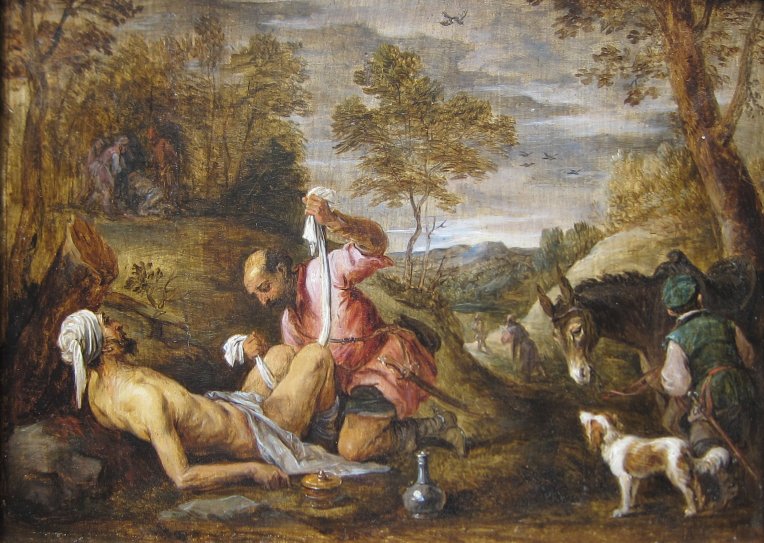
Today we hear one of the more famous parables of Jesus.  The Parable of the Good Samaritan ought profoundly to shape our spiritual and moral lives.  That order of things is important, however:  spiritual and then moral.

Although in a deeper sense there ought not be a distinction between our spiritual and moral lives, on the practical level, differences do mark the two.  We might say that the two are most sharply distinguished by sin.  The “scholar of the law” who “wished to justify himself” wants to be moral, but not spiritual.  Jesus demands that he be both, and that he be moral by being spiritual.

Mercy is the means by which the moral life is wedded to the spiritual life.  Or rather, mercy is the means by which the spiritual life begets authentic moral choices.  Were we not all children of Adam and Eve, fallen creatures, our moral choices would not demand mercy.  But in this world of sin and corruption, mercy is divine charity’s common currency.

In our spiritual lives, we look on each of our fellow human creatures through the eyes of God the Father.  We love each sinner, beaten and wounded by the sins of himself and others, with the mercy through which the Father sent His innocent Son to be slain for us.  Through this love, we can choose to serve the broken, bind the wounded, and know that in this service we serve God as well.
Saturday of the Twenty-sixth Week in Ordinary Time [II]

Saturday of the Twenty-sixth Week in Ordinary Time [II]
Job 42:1-3,5-6,12-17  +  Luke 10:17-24
October 3, 2020

“… you have revealed them to the childlike.”

It’s rare for Jesus, in any of the four Gospel accounts, to speak directly to God the Father.  Because of this rarity, we ought to privilege those verses where we get to “overhear” Jesus address His divine Father.  We might even consider these verses as models for our own prayers, inasmuch as through Baptism we are adopted children of God the Father.

First, we ought to note the context of Jesus’ words to God the Father.  The 72 disciples have returned to Jesus rejoicing that demons are subject to them because of Jesus’ name.  However, Jesus tells them not to rejoice because of such power over demons, but to rejoice instead because their names are written in Heaven.  Jesus is subordinating the disciples’ ministry—as important as it is—to the relationship that each has with the One Jesus teaches them to address as “Our Father, who art in heaven”.

Also, it’s important to note that St. Luke the Evangelist immediately prefaces the words of Jesus to God the Father with the observation that Jesus “rejoiced in the Holy Spirit”.  This is significant because St. Luke, more than the other three evangelists, stresses the role of the Holy Spirit in the life and ministry of Jesus Christ.  Here, the words by which Jesus praises the Father are spoken “in the Holy Spirit”.  As the Holy Spirit is the love of God the Father and God the Son for each other, so by the Holy Spirit each adopted child of God finds the inspiration to pray to God more fervently and authentically.

The Holy Guardian Angels

The Holy Guardian Angels
Job 38:1,12-21;40:3-5  +  Matthew 18:1-5,10
October 2, 2020

“… their angels in Heaven always look upon the face of my heavenly Father.”

Our Guardian Angels shed light upon the path that we must walk.  When our struggles each day seem too great, they extend a ray of hope down upon us from God.  They allow us to see the face of Our Crucified and Risen Lord, who having shared in our suffering helps us share in His Resurrection, even in the midst of suffering.

Our Guardian Angels guard us from the snares of our enemies.  As the Devil tries time and again to convince us that his way—easier and broader than God’s—is the way that will bring us happiness, our guardians remind us that the Way of the Cross is the only path to the Father.

Our Guardian Angels rule us as we slip from the narrow path.  As we fall prey to the temptations of the Devil, our guardians do not abandon us.  Sharing in the boundless love of our Savior, they do not fail to stand by us even then.  They convince us, as they nurse our consciences back to health, that the Cross is the only true remedy for our constant falling away from God.

Our Guardian Angels guide us by bidding us to share in the sacraments of the Church.  For all their power, our guardians entrust us to the care of Holy Mother Church, since in her care we most truly belong.  For the Church is their Mother, too.  All the angels are fellow members of the Church, and as the Church’s children we imitate the words of Jesus when like little children we recognize and thank those who are our guardians.