The Exaltation of the Holy Cross

The Exaltation of the Holy Cross
Numbers 21:4-9  +  Philippians 2:6-11  +  John 3:13-17
September 14, 2020

… He humbled Himself, becoming obedient to death, even death on a cross.

We know that silence can be deafening.  Sometimes silence is very embarrassing, as when a teacher asks a question about something that’s been studied for weeks, and no one knows the answer.

On the other hand, silence can be a very good thing.  It is in silence that the highest kind of prayer happens.  St. John of the Cross is supposed to have said that silence is God’s native language.  Regardless, there are many different ways to pray.  One of the first ways that we learn is prayers that others teach us, like the “Our Father”, the “Hail Mary” and the “Glory Be”.  Prayers like these let us pray together as a group, so that we’re praying the same thing at the same time.

Other times, though, we pray on our own, and so we make up our own words in prayer.  In this kind of prayer—which is like a conversation with God—we can say anything we want.  We don’t have to remember the right words to pray.  We just pray from our heart, and offer to God whatever is most on our mind.

But there’s another part of prayer that sometimes gets overlooked.  That is silence.  Actually, in our prayer, most of our time should be spent listening rather than speaking.  As the saying goes, this is why God gave each of us two ears, but only one mouth:  we are to listen twice as much as we talk.  This is as true of prayer as it of conversations with our fellow human beings.

It is in our silence—in listening to God—that our deepest prayer can take place.  This makes sense, if we think of it, because after all, isn’t what God wants to say to us probably more important than what we want to say to Him?

Humility is one of the virtues, and silence is one form of humility.  That’s why it’s often difficult to quiet ourselves down.  When we’re forced to be silent, we usually want to talk instead.

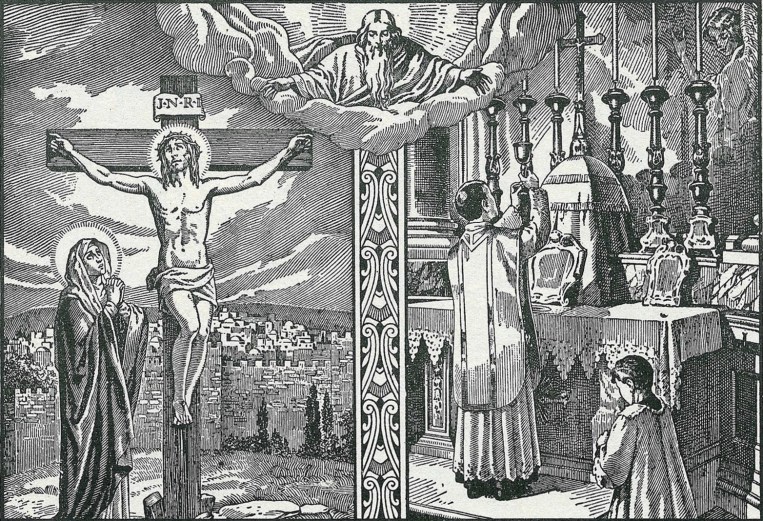
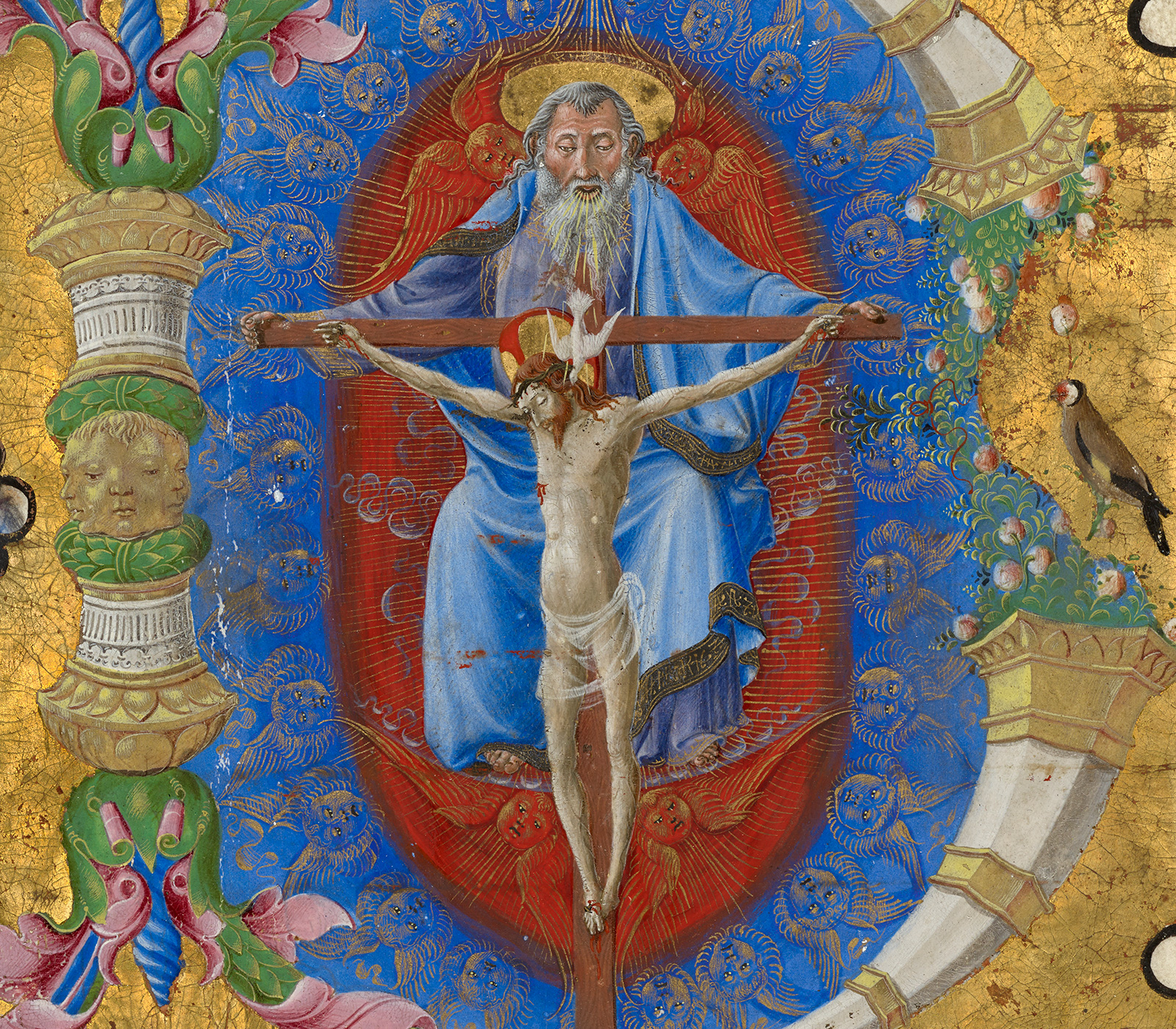
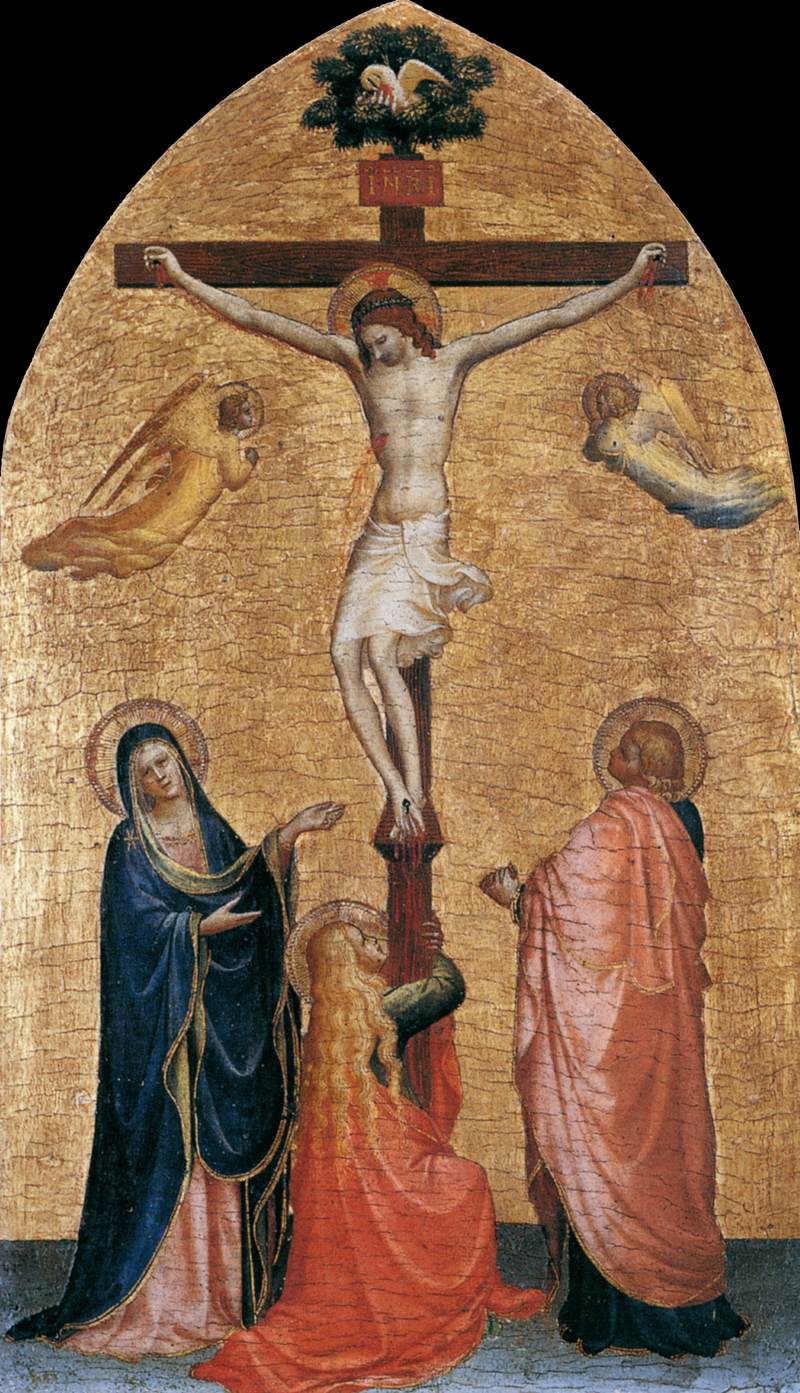
Even though we have lots of opportunity to grow in humility, as human beings our greatest call to be humble is when we face death:  the deaths of others whom we love, but eventually, our own death.  This is where Christ reveals to us God’s love.  This is what we celebrate today, on the Feast of the Triumph (or Exaltation) of the Holy Cross.

Picture in your mind the scene at Calvary.  Saint John was the only apostle who stood at the foot of the Cross in silence, and it was into his care that Christ, the only child of Mary, entrusted His Blessed Mother.  In turn, Christ entrusted John to the care of Mary.  In these words we hear the only teaching that is possible from the Cross:  that we must entrust ourselves to each other’s care, bound to each other by Our Father’s love.

Saturday of the Twenty-third Week in Ordinary Time [II]

Saturday of the Twenty-third Week in Ordinary Time [II]
1 Corinthians 10:14-22  +  Luke 6:43-49
September 12, 2020

My beloved ones, avoid idolatry.

In today’s First Reading Saint Paul poses a juxtaposition that might at first seem odd.  He bids his beloved to “avoid idolatry”.  That certainly seems like a command to be found in Scripture.  But then he begins speaking about the Eucharist.  He rhetorically asks whether the Eucharist is indeed “a participation in the Blood of Christ” and the “Body of Christ”.  Why is he setting the offering of idolatry directly against the Eucharist?  What, practically, is St. Paul trying to get across to us?

Both idolatry and the Eucharist, of course, are offerings.  On the one hand, idolatrous offerings are made to “false gods”, some of whom do not exist, and some of whom are no more than created demons.  Such sacrifice is in vain inasmuch as religious offering are meant to pay honor or ask pardon from one to whom such offerings are due.

On the other hand, the Eucharist is offered to the Lord, the only and true God.  But that’s not the only difference.  The one true God became man, so as to be able to share in the act of sacrifice:  to offer His own Body and Blood, soul and divinity.  Demons only accept sacrifice from others; they will not descend to sacrifice of themselves.  In the Eucharist, the God-man gives us the very strength needed to share in the sacrifice of self.

Friday of the Twenty-third Week in Ordinary Time [II]

Friday of the Twenty-third Week in Ordinary Time [II]
1 Corinthians 9:16-19,22-27  +  Luke 6:39-42
September 11, 2020

“Remove the wooden beam from your eye first ….”

When you make your nightly examination of conscience, and prepare monthly for the Sacrament of Reconciliation, there’s a simple way to recollect yourself for the needed self-scrutiny.  After all, if it’s been a long day or month, we can feel overwhelmed and unsure how to assess our efforts to live (or our failures to live) in Christ.

This simple means is to recall that all the commandments of the spiritual life converge in Jesus Christ.  What does this mean?  Today’s Gospel passage offers a concrete example.  The imagery with which Jesus preaches today seems only to be about the challenge of loving our neighbor:  specifically, a sinful (“blind”) neighbor.  But the two great commands of Jesus—to love God fully, and to love our neighbor as our self—converge in Him.

We are not to look down on our sinful brother, but rather to look up to him.  This is possible because of our authentic need for humility.  Christian humility is in one sense nothing more than honesty.  Both my brother and I are sinners.  We are equal in this.  But Jesus calls me to serve as brother as if I were serving Jesus Himself.  For this reason, from my state of sinfulness, I look up to my sinful brother.  From this stance, I may help him remove the splinter from his eye.  Jesus, of course, never sinned, but He did “become sin”—in the phrase of St. Paul—so that in my sinful brother I can see the Jesus whom I am to serve.

The Twenty-fourth Sunday in Ordinary Time [Year A]

The Twenty-fourth Sunday in Ordinary Time [A]
Sirach 27:30—28:7  +  Romans 14:7-9  +  Matthew 18:21-35

Wrath and anger are hateful things, yet the sinner hugs them tight.

references to the Catechism of the Catholic Church cited for this Sunday by the Vatican’s Homiletic Directory:

CCC 218-221: God is love
CCC 294: God manifests his glory by sharing his goodness
CCC 2838-2845: “forgive us our trespasses”

+     +     +

The great British convert and apologist G. K. Chesterton once said, “Forgiving means to pardon the unpardonable, or it is no virtue at all.”  By contrast, you and I often are willing only to forgive if we deem someone’s sins not too serious or offensive.  Today Jesus challenges us to go further in being instruments of His Divine Mercy.

On this Sunday in the midst of Ordinary Time, we ought to think back to the Sunday after Easter Sunday.  The Church calls this day Divine Mercy Sunday, in honor of Jesus instituting the Sacrament of Confession in the evening following His Resurrection.  The gift of this Sacrament is anything but ordinary.  Yet the fruits of this sacrament are meant to help each Christian face the ordinary challenges of forgiving others as we have been forgiven.

One way to realize to what extent we ought to extend mercy to others is to turn the table.  We ought each day to consider how much God Himself has blessed us in showing us His mercy.  We ought to remember that each day we act sinfully, in a way that calls for God’s mercy.

All of us long to find a place where we are at home, where we are trusted.  But even more importantly, we long to find a place where we can be forgiven, for we know that there are times when we fail to live up to the trust that people place in us.  We might ask ourselves, “Which is more important to me:  trust or forgiveness?”

If we look to our own experiences, it’s easy to answer these questions.  When we consider the workplace, we can hope that our employers or supervisors might be patient and help us when we have trouble with a task.

But if we were to imagine our worst Monday, a day in which hour after hour produced nothing but terrible results, and finally ended in a major blunder or misjudgment, we might naturally expect to receive a pink slip instead of forgiveness.  Businesses have to trust people, or they wouldn’t have any employees.  But they do not have to forgive endlessly.  They can only tolerate a certain amount of error.  After that, the relationship is over.

All of us long to find a place where we feel at home, which first and foremost means a place where we know we can experience forgiveness despite our sins.  We want a home where our relationships are not defined by, or at risk of termination because of, our sins.

Home is not simply where the heart is, but where the forgiving heart is.  The home in which we find the deepest sort of forgiveness, a selfless and generous forgiveness that seeks to build up the one who has transgressed:  this is our truest home.

The Church, wherein we share in the Body of Christ, is our truest home both on earth and in Heaven.  By right, we should feel most at home there, before its altar, because it is there that we revel in the source of all forgiveness.  When the priest speaks those words that Christ spoke at the Last Supper, we are taken into that home where forgiveness was first given by the God-man, when He said, “This is the Cup of My Blood.  It will be shed for you and for all, so that sins may be forgiven ….”

But in this home, we find not only forgiveness.  In our home which is the Church, sharing in the Eucharist means giving thanks not only for the forgiveness wrought by Christ’s Sacrifice on the Cross.  We also give thanks for the fact that when we share fully in this sacrament, we receive not only a share in Christ’s forgiveness.  We receive a share in the life of Christ himself.  We receive not only the Forgiver’s forgiveness.  We receive the Forgiver.

To receive forgiveness is to be restored to our former self.  But to receive the Forgiver means not simply that we’re restored to our former self, but that we’re raised from our state of sinfulness even beyond our old self, to a share in the life of the Forgiver’s Self.  We share in the life of Christ, and so are asked to offer forgiveness to others as Christ does:  to all persons, in all circumstances, forever.

Thursday of the Twenty-third Week in Ordinary Time [II]

Thursday of the Twenty-third Week in Ordinary Time [II]
1 Corinthians 8:1-7,11-13  +  Luke 6:27-38
September 10, 2020

“Do to others as you would have them do to you.”

In today’s Gospel passage Jesus bids us to follow the Golden Rule.  “Do to others as you would have them do to you.”  The Golden Rule is heard within the setting of admonitions by which Jesus leads us to share in His Cross:  “Love your enemies.”  “Do good to those who hate you.”  “Pray for those who mistreat you.”  These admonitions are examples of living out on the moral and spiritual planes what Jesus accomplished on the Cross.

We all know that it’s very hard to live out these admonitions.  But it’s good to remember that Jesus is not only our teacher, who set us an example on the Cross.  He is also our Savior, who from the Cross on Good Friday bestows grace upon all who beseech Him as they strive to imitate Him.

In the final part of today’s Gospel passage Jesus offers us some rhetorical questions.  The first is representative:  “If you love those who love you, what credit is that to you?”  By the questions that follow Jesus leads us to see the Face of His heavenly Father.  When we live the Golden Rule, we will be “children of the Most High”.  Finally, to sum up everything He’s been exhorting us to live, He offers a simple principle that you and I might take and repeat throughout this day whenever there is a quiet moment:  “The measure with which you measure will in return by measured out to you.”

St. Peter Claver, Priest

St. Peter Claver, Priest
1 Corinthians 7:25-31  +  Luke 6:20-26
September 9, 2020

“Woe to you when all speak well of you.”

“Woe to you when all speak well of you.”  These words of Jesus seem at first hard to reconcile with the honors we confer on the canonized saints of the Church.  If we took the words of Jesus literally, then the praise given the saints would be wrong.  Then again, what of our speaking well of Christ Himself, and praising Him?  We don’t doubt that we ought to praise Christ, but given that fact, how do we understand His words in today’s Gospel passage?

What Jesus teaches in this passage—and in all the Lucan Beatitudes—is that a Christian can only find consolation in one place:  within the Holy Spirit.  None of the things which Jesus preaches against is bad.  Money, food, laughter, and praise are all good things.  The evil which distorts and perverts these good things, however, is the temptation to rest in them:  that is, to believe that these things can make us happy for any longer than a mere moment.

It is when we root good things such as money or praise within our earthly selves that they become that source of evil that Christ is preaching against.  May the grace of the sacraments help us to offer all our pleasures in life to God, and admit that none of them can save us from being rooted in this world.

The Nativity of the Blessed Virgin Mary

The Nativity of the Blessed Virgin Mary
Micah 5:1-4 [or Romans 8:28-30]  +  Matthew 1:1-16,18-23
September 8, 2020

“She will bear a son and you are to name Him Jesus ….”

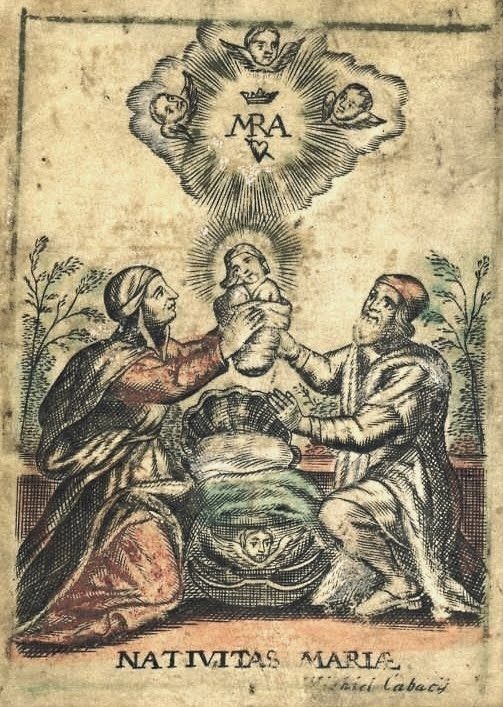
As the Church today celebrates the nativity of Mary, we reflect on human nature.  In the great universities of the Church, this is the study of theological anthropology:  that is, the study of man vis-à-vis God who is man’s Creator, Redeemer and Sanctifier.  God in Himself—as Father, Son and Holy Spirit—had no need whatsoever to create man.  Nor did He have need to care for fallen man.

But God chose, and still chooses, to redeem and sanctify individuals.  He does this through Christ Jesus, who entered our world through the life of Mary.  In the field of theological anthropology, Jesus and Mary stand at the head of our prayer, reflection, and study:  Jesus as a divine Person who took on a human nature, and the Blessed Virgin Mary as the perfect human creature.

Today we hear in the Gospel about the family tree of Jesus.  There were some great figures in Jesus’ family tree, such as King David.  But most of the people in Jesus’ family were very ordinary.  Maybe the most ordinary was Mary.

That might seem strange to say, because we might want to say that Mary was the most extraordinary.  Of course, Mary was the most holy of Jesus’ ancestors:  she was the only person to come before Jesus who had never sinned.  But still, at the same time, Mary was really the most ordinary person to come before Jesus.

If you were to walk down a busy street in a large city, and Mary walked by you, you probably would never recognize her.  That’s because Mary lived out the Gospel so fully.  She lived out the Gospel even before Jesus became a human being.  It’s because Mary lived out the Gospel so completely that Jesus became a human being.  But living out the Gospel is really very simple, very quiet, and very ordinary.  It doesn’t mean being famous, or looking for attention from others, or wanting to be better than those around you.

For me to live the Gospel means living like Mary:  listening for God’s voice every day, letting his Will for my life sink into my heart, and carrying out that will with the love of my own human heart.

Monday of the Twenty-third Week in Ordinary Time [II]

Monday of the Twenty-third Week in Ordinary Time [II]
1 Corinthians 5:1-8  +  Luke 6:6-11
September 7, 2020

But they became enraged and discussed together what they might do to Jesus.

Jesus in today’s Gospel passage (and on many other occasions during His earthly life, leading to the Cross) faced those who had turned the meaning of religion inside out.  Jesus in this passage heals the man with the withered hand, and the response of the scribes and Pharisees is to become enraged:  they discussed together what they might do to Jesus.

In this we see a similarity between Jesus’ day, and our day:  a similarity between the world of Jesus, and the world in which we live.  The world in which we live today may be much larger than Jesus’ world:  there may be more countries, and more peoples who have to speak with each other, and work to get along.  Likewise, the Church today extends throughout the world instead of consisting of a small band of disciples.

Yet there are today people, just as in Jesus’ day, who return evil for good:  whose actions make no sense.  Whether we reflect upon the example of the scribes and Pharisees in today’s Gospel passage, or Pontius Pilate, or Judas Iscariot, the question we have to ask is:  how did Jesus respond to those who hated Him, and nailed Him to the Cross?  Can we be like our Lord Jesus, even in a situation like this?

Saturday of the Twenty-second Week in Ordinary Time [II]

Saturday of the Twenty-second Week in Ordinary Time [II]
1 Corinthians 4:6-15  +  Luke 6:1-5
September 5, 2020

“What do you possess that you have not received?”

St. Paul in yesterday’s First Reading referred to Christians as “stewards of the mysteries of God”.  In today’s First Reading Saint Paul continues to preach on the topic of stewardship, noting that everything in our life is a “given”.  But if this is so, he rhetorically asks the Corinthians, why are they “boasting as if [they] did not receive it?”  In fact, the “givenness” of our lives and everything in them calls for humility from us.

But St. Paul goes further.  In describing himself and the other apostles, he debases himself for a specific purpose.  He describes the apostles as being “like people sentenced to death”, as “fools on Christ’s account”, and “like the world’s rubbish, the scum of all”.  At the same time, he raises up those whom he serves, saying that the apostles are weak, but the Corinthians are strong, and that the Corinthians are held in honor, but the apostles in disrepute.

These points are made to admonish the Corinthians as Paul’s spiritual children.  Here he reveals his motive in this passage of his letter:  to beget in his children the humility that will foster spiritual growth.  He concludes with a verse that contradicts those who say that Christians—such as priests—cannot serve as spiritual fathers:  “I became your father in Christ Jesus through the Gospel.”