The Twentieth Sunday in Ordinary Time [A]

The Twentieth Sunday in Ordinary Time [A]
Isaiah 56:1,6-7  +  Romans 11:13-15,29-32  +  Matthew 15:21-28

“For God delivered all to disobedience, that He might have mercy upon all.”

references to the Catechism of the Catholic Church cited for this Sunday by the Vatican’s Homiletic Directory:

CCC 543-544: Kingdom first to Israel, now for all who believe
CCC 674: Christ’s coming hope of Israel; their final acceptance of Messiah
CCC 2610: power of invocation with sincere faith
CCC 831, 849: the catholicity of the Church

Love is what moves people through life.  Love is what motivates.  Love is what gives meaning to life.

But what is true love?  What does real love look like?  The world defines love in countless ways, many of which contradict each other.  If you flip through television or YouTube channels, you’re likely to find a different definition of love offered by each channel.  Love of money, love of possessions, love of knowledge, love of pleasure:  all of these are definitions of love that the world offers for our belief.

The Church proclaims that the love of God is symbolized by the crucifix.  If we want to know what love is, that’s all the further we have to look.  But to understand the love of God, and to make it part of our own lives, is something much different and more difficult.  It requires faith.

This Sunday’s Gospel Reading shows us how faith becomes love.

The dialogue between Jesus and the Gentile woman shows how God relates to each of us who, like the Gentile woman, is a sinner.  This dialogue also shows how God wants us to relate to Him:  both in our daily lives, and from the broader perspective of our spiritual growth over the years.

In the Gospel Reading, the evangelist St. Matthew tells us that a Canaanite woman—which is to say, an outsider—came to Jesus and called out, “Have pity on me, Lord, Son of David!”  This woman, despite not being one of the people who had been waiting for the Messiah, nonetheless knew who Jesus was.  So she cried out to Him for help.  But what happened next?

Jesus did not say a word in answer to her.  Not a word!  Here is a woman whose daughter is being tormented, yet Jesus did not say a word in answer to her.  What kind of love is this?  If you have ever prayed intensely for a serious problem, and felt that God did not answer your prayer, you can identify with this Gentile woman.

But can you identify with her faith?  Perhaps you can identify with her cry for help going unanswered, but can you identify with what the woman does next?  She is a woman whose faith is not shaken, and who puts her faith into action time and again.  She reaches out to Jesus a second time, and simply says, “Lord, help me.”  But what is Jesus’ response?

He calls the woman a dog!  He says to this outsider, “It is not right to take the food of the children and throw it to the dogs.”  The “children” Jesus is referring to are the children of Israel, the ones the Father sent Him to teach, while this woman is an outsider, a “dog”.  But why is Jesus talking this way?

God demands faith from us, even when we believe we have none.  What’s more, He is willing to “pull” our faith out of us—indeed, to test us—in order to purify our faith.  Jesus knows what sort of faith this woman has.  He is willing to draw it out, because without faith on this woman’s part He will not bestow His love by working a miracle.

Faith is always required for God to work in our lives.  God requires faith:  that is, He demands it from us.  Whenever you read the Gospel and see an occasion where Jesus chooses not to work a miracle, it is not because His divine power has “run out”.  Without faith on our part, God’s grace—His love—would be an empty gift.  But what kind of faith does God want from us?

The faith that God wants from us is not passive.  It’s active.  God does not want the sort of faith that says, “God is going to take care of everything, so I can sit back and coast.”  That is not our Catholic understanding of faith.  Faith involves something active on our part.  It demands constant prayer.  It demands the sort of dialogue that we hear between Jesus and this Gentile woman.  We might even say that God wants us to challenge Him in our prayer, so that He might challenge us to greater faith, and thereby greater love.
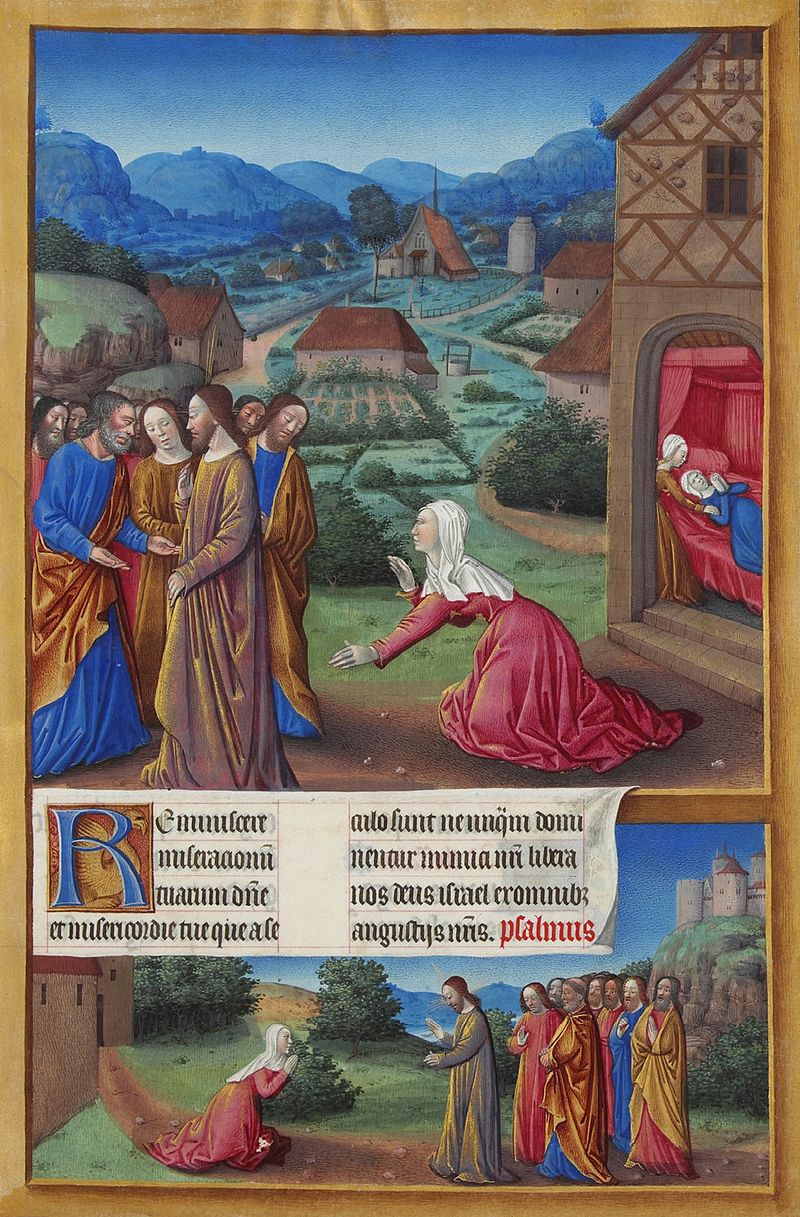
OT 20-0AJesus Exorcising the Canaanite Woman’s Daughter from Très Riches Heures du Duc de Berry, 15th century

The Assumption of the Blessed Virgin Mary

The Assumption of the Blessed Virgin Mary
VIGIL:  I Chr 15:3-4,15-16; 16:1-2  +  1 Cor 15:54-57  +  Lk 11:27-28
DAY:  Rev 11:19;12:1-6,10  +  1 Cor 15:20-27  +  Lk 1:39-56
August 15, 2020

“… my spirit rejoices in God my Savior ….”

We Catholics believe that when a person dies, if he is in a state of perfect grace, his soul goes directly to Heaven.  To use another word, we believe that his soul is “assumed” into Heaven.  We may know people in our own families who, we’re sure, had their souls taken by God directly into Heaven.  This may happen with many people who had time to prepare for a holy death.  The main difference between the end of these persons’ lives and the end of Mary’s life is that both Mary’s soul and her body were assumed into Heaven.

Why was Mary’s body taken into Heaven along with her soul?  It’s because Mary is the type of person that all of us were originally supposed to be, but didn’t become because of Original Sin.  If Adam and Eve, and all of us in turn, had never sinned, then every one of us would rise body and soul into Heaven at the end of our lives.  Death as we know it (including the separation of body and soul) only exists because of human sin.

Yet Mary was given a special gift by God, since God knew from eternity that she would accept His calling to be the Mother of Christ.  This gift was the privilege given at the first moment of Mary’s existence:  the privilege of her Immaculate Conception.  The fact that she was conceived by her mother, St. Anne, without Original Sin meant that her whole life was uniquely holy among all God’s creatures.  Her life was still filled with struggles and pain, but at the end of her life on this earth, Mary became a sign of hope for us.

Because Mary was never touched by the effects of Original Sin, and because she never chose to sin, she didn’t suffer the corruption of her body.  Her soul and her body remained united at the end of her earthly life, and both were taken up into Heaven.

Mary is the perfect example of what it means to take the gifts given by God and use them completely for good.  Because Mary faithfully accepted the great gift of being the Mother of Jesus, the Mother of God, and because she always stood faithful to Christ, even as he was dying on the Cross, she was protected by God from one of the effects of Original Sin:  that body and soul should be separated at the time of death.

So when the end of Mary’s life came, she became the sign that shows all of us our own destiny as disciples of Christ.  When we die, our souls and bodies will be separated for quite some time:  until the end of time, in fact.  Nonetheless, if you and I follow Christ even when it means embracing the Cross—if we are always willing to use the gifts God has given us for good and not evil—then when Christ comes a second time, our bodies will be raised by Christ and rejoined to our souls.  With our Blessed Mother in Heaven we will all thank God for the gift of life.  We shouldn’t forget that we proclaim this hope in our Creed when we pray, “We believe in the resurrection of the body.”  Mary experienced this gift in a unique way immediately at the end of her earthly life.

Assumption - Reni

Thursday of the Nineteenth Week in Ordinary Time [II]

Thursday of the Nineteenth Week in Ordinary Time [II]
Ezekiel 12:1-12  +  Matthew 18:21—19:1
August 13, 2020

“So will my heavenly Father do to you, unless each of you forgives his brother from his heart.”

Our truest home is the home where we find the deepest sort of forgiveness.  In this home we find a selfless and generous forgiveness that seeks to build up the one who has committed a transgression.  The Church, through which we share in the Body of Christ, is our “home of homes”.

By right, we should feel most at home before the altar, because it is there that we rejoice in the source of all forgiveness.  But in the Church during the Eucharist, we give thanks not only for the forgiveness wrought by Christ’s Sacrifice on the Cross.  We also give thanks for the fact that when we share fully in the Eucharist, we receive not only a share in Christ’s forgiveness; we receive a share in the life of Christ himself.  We receive not only the Forgiver’s forgiveness.  We receive the Forgiver.

To receive forgiveness is to be restored to our former self.  But to receive the Forgiver means something greater.  It means not simply that we’re restored to our former self, but that we’re raised from our state of sinfulness even higher than our original state, to a share in the life of the Forgiver’s Self.  We share in the life of Christ, and so are given the power to forgive others as Christ offers forgiveness:  to all persons, in all circumstances, for ever and ever.

OT 19-4

Wednesday of the Nineteenth Week in Ordinary Time

Wednesday of the Nineteenth Week in Ordinary Time
Matthew 18:15-20

“… where two or three are gathered together in my name, there am I in the midst of them.”

Jesus, in today’s Gospel Reading, explains how His followers can keep from having moral punishment fall upon them.  Jesus preaches that His followers must seek reconciliation with each other.  He also calls upon us to point out a wrong that may have been committed, especially one which destroys harmony and peace.  Correcting others in this way is a very hazardous duty.  Like almost no other responsibility that we have as Christians, it calls for the virtues of prudence, courage, and meekness.  Who can manage this without the help of the Holy Spirit?

Jesus also urges us to pray together.  Individual prayer is indispensable, and Jesus elsewhere in the Gospel commands us to go to our rooms and pray in private:  but that’s not the limit of our prayer.

Where two or three are gathered in Jesus’ Name, He is there in their midst.  But we also know that where two or three are gathered at Holy Mass, Jesus is not only there in their midst, but becomes present in a way that they can receive Him:  Body and Blood, soul and divinity.

OT 19-3

St. Clare, Virgin

St. Clare, Virgin
Ezekiel 2:8—3:4  +  Matthew 18:1-5,10,12-14
August 11, 2020

“See that you do not despise one of these little ones ….”

For you to be a saint means to live your life in Christ, and at the same time to allow Christ to live His life in you.  This simply means having the relationship between Jesus and His Father live in your own heart and mind.  This is something mystical, and so difficult to describe in language.  Nonetheless, it’s part and parcel of being a Christian.  It’s not just for cloistered monks and nuns.

By contrast, it’s not as if an ordinary Christian first reads from the Bible about Jesus and the Father, and then says, “Gee, I’d like to have that kind of relationship with God the Father.  I think I’ll try to imitate Jesus.”  You cannot enter a relationship by means of imitation.  To think that one can is to put the cart before the horse.

To think that one can is to ignore the truth that at your baptism, the two events of being adopted by God the Father and becoming a member of the Mystical Body of Christ are part and parcel of each other.  Both are accomplished at the same time by God the Father’s love.  In other words, it’s not so much that Jesus is our “older brother” spiritually, whose relationship with the Father we admire and then try to imitate.  Rather, it’s as members of Christ’s own Mystical Body that you and I share in the sonship of Jesus.

To ignore all this—to put that cart before the horse—is to forget that any relationship between a father and child is based on the primacy of the father’s love.  We don’t focus upon this enough in our time of meditation.  Especially in a culture like ours, children are at risk of believing that it’s their accomplishments that earn them their earthly fathers’ and God’s love.  But the Beloved Disciple in his first epistle reminds us of that key truth of the spiritual life, that “in this is love:  not that we have loved God, but that He has loved us, and offered His Son as an expiation for our sins” [1 John 4:10].

OT 19-2

St. Lawrence, Deacon and Martyr

St. Lawrence, Deacon and Martyr
2 Corinthians 9:6-10  +  John 12:24-26
August 10, 2020

… whoever sows bountifully will also reap bountifully.

The First Reading and Gospel Reading for today’s feast of Saint Lawrence both lay before us images of agriculture:  sowing seed, a grain falling to the ground and dying, and reaping bountifully.  These images relate to a holy martyr apropos Tertullian’s dictum that “the blood of the martyrs is the seed of the Church” [Apologeticus, Chapter 50].

In another sense, the martyr himself or herself is the seed that Jesus speaks of in this passage.  In this regard, Jesus’ words reveal the martyr to be an icon of Christ Himself.  “Whoever serves me must follow me, and where I am, there also will my servant be.”  We might choose simply three words from this sentence, and see how many points of meditation the Holy Spirit surfaces for us; those three words being “where I am”.

These three words call to mind the Divine Name revealed to Moses.  While God in His divinity is in all things, above all things, and is everywhere that is, Jesus Christ in His humanity dwelt among us sinners.  He dwelt first within Mary at the site of the Annunciation, then dwelt in the manger at Bethlehem, and then dwelt for many years in the home at Nazareth before beginning His public ministry.

Yet His ministry culminated in His self-offering at Calvary, and above anywhere else that He dwelt in this fallen world, Mount Calvary is the location that reveals the meaning of this phrase that Jesus speaks today:  “where I am”.  Jesus calls us to join Him in His self-offering, standing fast at the foot of His Cross.  There is where Jesus speaks of when He declares, “where I am, there also will my servant be.”

St. Lawrence - Fra Angelico

Saturday of the Eighteenth Week in Ordinary Time

Saturday of the Eighteenth Week in Ordinary Time
Matthew 17:14-20

“… if you have faith the size of a mustard seed, you will say to this mountain, ‘Move from here to there,’ and it will move.”

Each week the Church gives her attention on Saturday morning and evening to the Blessed Virgin Mary, as a sort of prelude to the Lord’s Day.  After all, if not for her act of faith at the Annunciation, the Lord would not have entered our world and accomplished our salvation as He willed to.

Our Blessed Mother is a model for us:  a model of faith, first and foremost, but a model of being honest with God, expressing our questions and weaknesses.  After all, it’s often our questions and weaknesses that keep both our faith from growing, and from acting upon our faith.

Jesus speaks in today’s Gospel passage to the faith that the Blessed Virgin Mary bore in abundance.  God’s gift to Mary of the Immaculate Conception prepared the way for her thoroughgoing faith, and allowed this faith to grow like the mustard seed through the power of the Holy Spirit.  Ask her intercession today, that you might be as open to God’s plan for your life as she continues to be, even in Heaven.

Friday of the Eighteenth Week in Ordinary Time [II]

Friday of the Eighteenth Week in Ordinary Time [II]
Nahum 2:1,3;3:1-3,6-7  +  Matthew 16:24-28
August 7, 2020

“Whoever wishes to come after me must deny himself, take up his cross, and follow me.”

Our souls need nourishment and healing before we spend our selves trying to solve the problems of our own lives and those of the world.  We must be willing to admit, first of all, that we are sinners, and that our sins seriously wound our souls.  Our souls need not only the nourishment of prayer, but the healing that comes from the forgiveness of our sins.  After all, it is in this regard that Jesus is our Messiah, our Savior.  God the Son became human not to save us from the Caesar, or from the IRS, or from our neighbors:  Jesus died to save us from the snares of the Devil.  God the Son became human not to take away our worries, or our financial debts, or our arguments with others:  Jesus died to take away our sins.

Once we regain this perspective in our lives, we realize how truly we need Christ’s help.  Yet at the same time, we hear Christ’s words to his disciples in today’s Gospel passage:  “Whoever wishes to come after me must deny himself, take up his cross, and follow me.”  Christ has died for us on the Cross, but we must join in His saving work.  We must do penance.  We must organize the time and energies of our lives so that they draw others closer to God.  In our speech, in the patience with which we do things and deal with others, through our charitable deeds, we can deny our sinful selves and become more like Christ.  And in doing all this, we should never underestimate or believe that we can imagine what graces God will bestow upon us through acting by means of His grace.

Tintoretto, La crocifissione, Sala dell'albergo, Scuola di San R

The Nineteenth Sunday in Ordinary Time [A]

The Nineteenth Sunday in Ordinary Time [A]
I Kings 19:9,11-13  +  Romans 9:1-5  +  Matthew 14:22-33

After the fire there was a tiny whispering sound.

references to the Catechism of the Catholic Church cited for this Sunday by the Vatican’s Homiletic Directory:

CCC 164: faith experiences testing
CCC 272-274: only faith can follow mysterious ways of providence
CCC 671-672: in difficult times, cultivate trust that all is subject to Christ
CCC 56-64, 121-122, 218-219: history of covenants; God’s love for Israel
CCC 839-840: the Church’s relationship to the Jewish people

This Sunday’s First Reading is iconic in the Church’s spiritual tradition.  Its most obvious lesson appears in light of the fact that the All-Powerful Lord, Creator of the heavens and the earth, chooses to manifest Himself to Elijah through a tiny, whispering sound rather than by more dramatic means.  This lesson encourages us to be mindful of God’s presence amidst what is small, simple, and seemingly insignificant.

This scriptural lesson can be compared to two other passages of Scripture.  Making these comparisons will set the stage for Sunday’s Gospel Reading.  Consider first the Lord’s self-revelation to Moses centuries earlier on the same mountain where He later appeared to Elijah.  It was on this occasion in Exodus 19 that the Lord entrusted the Ten Commandments to Moses.  The Lord did manifest Himself at that time through dramatic means:  thunder and lightning, fire and a heavy cloud of smoke, and the violent trembling of the whole mountain.  The radically different ways in which the Lord revealed Himself to Moses and Elijah offer complementary views of the Lord’s power in all things, great and small.

However, that contrast demands that we give our attention also to the similarity of the responses of Moses and Elijah to the Lord’s self-revelation.  Elijah hid his face in his cloak and went and stood at the entrance of the cave on Mount Horeb.  He recognized the tiny, whispering sound for what it was, and so adhered to the divine warning:  “my face you cannot see, for no man sees me and lives” [Exodus 33:20].  Elijah’s awe-filled reverence of the Lord echoes the reverence of Moses, who on the same mountain had been commanded by the Lord:  “Take care not to go up the mountain, or even to touch its base.  If anyone touches the mountain he must be put to death” [Exodus 19:21].  Both Moses and Elijah give their attention to the Lord Himself, not to the manner of His appearance.

Sunday’s Gospel Reading presents a sharper pair of contrasts.  After sending the disciples ahead across the water, Jesus went up on a mountain by Himself to pray.  We cannot know what this simple, serene contemplation with God the Father, in the Holy Spirit, was like for Jesus.  But it’s obvious that Jesus is not bound by any command similar to the one given to Moses.  Jesus ascends this mountain in order to gaze directly on His Father’s countenance, through His humanity, in the fullness of His divinity.

Stronger yet is the contrast made by Jesus’ outreach to Peter.  At 3:00 a.m., amidst darkness and strong winds, Jesus walks on the water towards His disciples.  He announces Himself to them, and emboldens them:  “Take courage … be not afraid!”  Yet Peter immediately expresses doubt and issues a challenge to Jesus.  When Jesus complies and commands Peter to walk to Him on the water, Peter is frightened by the wind and begins to sink.  But Peter does not end up sinking, for Jesus reaches out to him.  In this, Peter symbolizes each of us.

God the Father sent His Son into our world to reach out to each of us and to offer reconciliation for our sins.  On the occasion heard in Sunday’s Gospel Reading, this divine Son stretches out a human hand to save Peter from his doubts.  Not only does Jesus not forbid His disciples to approach, gaze upon, and touch Him.  Jesus reaches out to and catches Peter.  The compassionate outreach of the God-man here stands in contrast, but not contradiction, to the reverential distance mandated by the Lord in the Old Testament.  Of course, these two are one and the same Lord.

It’s not as if God became more compassionate with the passing of millennia.  All the whys and wherefores of salvation history—including the prudence of divine Providence—may perplex us.  We should not underestimate the significance of the Old Testament’s lessons.  Each of us sinners needs to approach our Lord with awe-filled reverence.  However, this reverence ought to be matched by our trust in the Lord’s desire to save us.  This desire has been fulfilled through the Incarnation of God the Son.  Jesus stretches out both arms on the Cross to catch us and keep us from sinking within the misery of our sins and into the depths of eternal death.

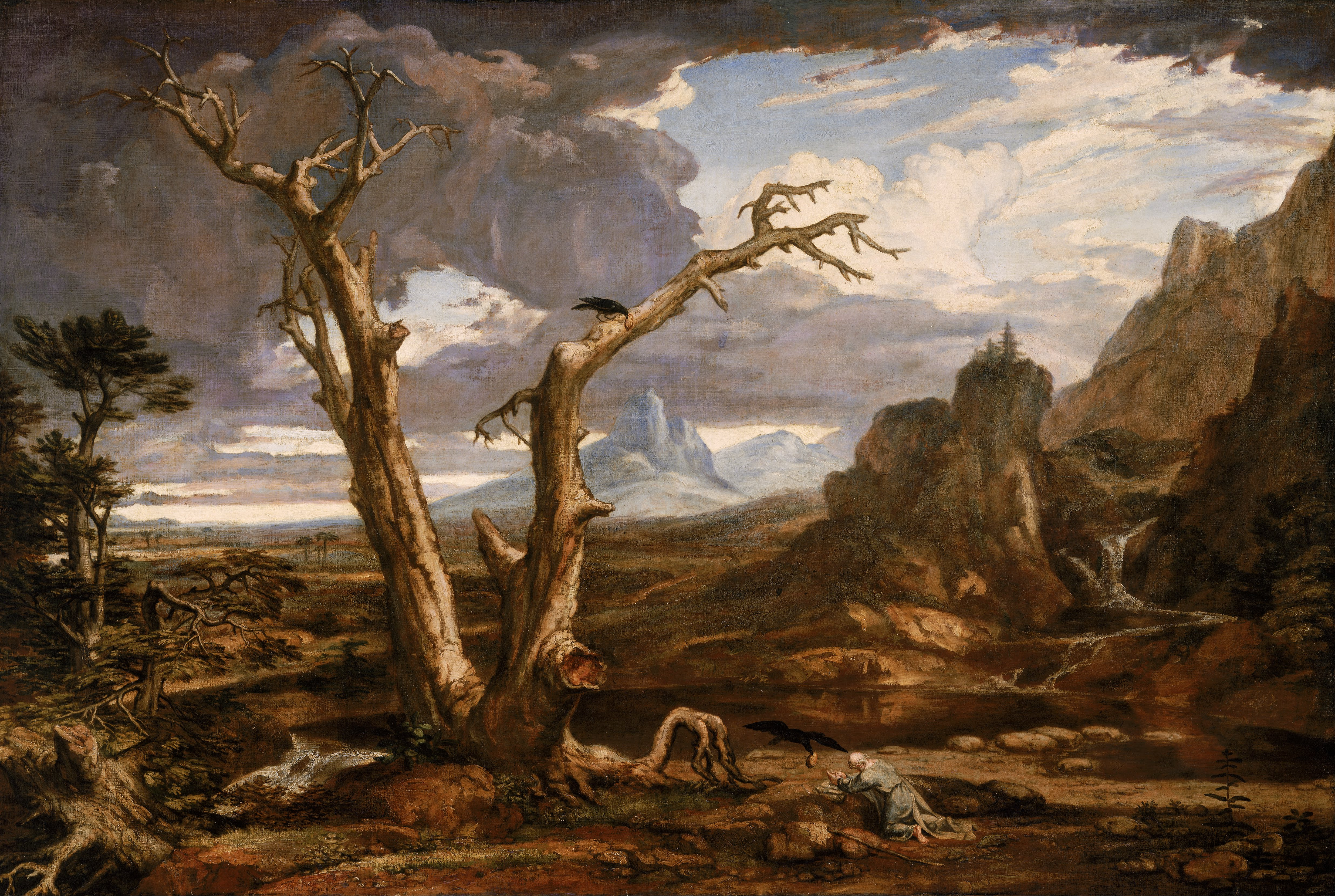
Elijah in the Desert by Washington Allston (1779–1843)