“… no one knows the Father except the Son and anyone to whom the Son wishes to reveal him.”
Today’s Gospel passage speaks to the power of divine revelation. Jesus speaks directly to His Father, something rare in the four Gospel accounts. Along with this exclamation, Jesus says, “no one knows the Father except the Son and anyone to whom the Son wishes to reveal him.”
But that’s not the only reference to divine revelation. In praising the Father, God the Son exclaims to Him that the reason for the Son’s praise is that “although you have hidden these things from the wise and the learned you have revealed them to the childlike.”
God the Son rejoices because His Father has revealed hidden things to the “childlike”. Here we have a complement to Jesus’ admonition that unless one becomes like a little child, he will not enter the Kingdom of Heaven. This entrance must be connected to those hidden things that escape the vision of the wise and the learned. The child has a capacity to see things as God wants them to be seen, and that includes the child who is God the Son, in all His divine humility.
“‘Will you be exalted to heaven? You will go down to the nether world.’”
“Teddy Bear Jesus” remains one of the more persistent myths within lands that are culturally Catholic (as distinguished from those that are Catholic by personal conviction, sweat, and blood). This mythic figure became flesh and dwelt among us to tell us how wonderful we are, and that we just need to have more self-esteem. As popular as this myth is within so much of the modern Western world, it has no basis in the New Testament. Today’s Gospel passage offers a helpful antidote.
In your hand missal, the two sentences that Jesus addresses to Capernaum may be printed in italics, drawing attention to the fact that they are a quotation from the Old Testament. Specifically, Jesus here is quoting a very “un-teddy-bear-like” passage from the fourteenth chapter of the Prophet Isaiah.
What has prompted Jesus in today’s Gospel passage to thunder tides of woe against the cities of Chorazin, Bethsaida, and Capernaum? Here is the more specific point for our reflection today: failure to repent.
Jesus has been preaching repentance because it’s a prerequisite for accepting the good news of the Gospel. No Christian should think that he doesn’t need to repent because he’s already been baptized, accepted the Gospel, and been saved. The gift of salvation first given in the Sacrament of Baptism certainly can be lost. But most importantly, we should remember that the motive for Jesus’ reproaches is the same as the motive for His carrying the Cross: love for each of us.
“Whoever finds his life will lose it, and whoever loses his life for my sake will find it.”
There is a big difference between a bribe and a gift. A bribe is something we give to another while demanding something in return. A gift is an expression of love with no strings attached. A gift-giver expects nothing in return, but merely gives the gift as a sign of love that already exists between the two.
This week the First Reading comes from the book of the prophet Isaiah. A prophet at roughly the same time as Hosea, whose prophecies we heard last week, Isaiah preached to the people of Judah, the southern half of the Kingdom. Isaiah was concerned with the sort of sacrifices that the people were offering to God. They viewed God as someone with a lot of power whom they could bribe.
The people of Judah had been influenced in this regard by their pagan neighbors. Jesus in the Gospel Reading, however, warns us that no one else should stand between ourselves and God. This seems very self-evident, but can in fact demand a lot of us as Catholics. Not even members of our family may be chosen above God.
This is a hard saying. It would seem that Jesus expects us to pit ourselves against our family in order to choose Him. But Jesus didn’t come to earth wanting to divide people, any more than He wanted to die on the cross for the sake of dying. He knew, though, that there are some who refuse to choose God in their lives, and that these people can only find peace in their own hearts when they come to God. Rather than look at Jesus’ words as pitting us against others, we realize that Jesus is telling us that if we want to draw others closer to God, we first of all have to firmly establish our own relationship with God. Out of that relationship with God, we can work at drawing others closer to God again.
“[N]ot one [sparrow] falls to the ground without your Father’s knowledge.”
Jesus preaches today about Our Father’s providential knowledge and will. “[N]ot one [sparrow] falls to the ground without your Father’s knowledge.” God knows all things. We know this abstractly, but perhaps we fail to consider all that this truth of our Faith means.
When we say that God knows all “things”, what sorts of things are we talking about? Facts that would win God a championship on trivia shows? Certainly God knows all objective facts about science, history, etc. But God’s knowledge is not trivial.
God’s infinite knowledge extends to what is most personal. God knows every action you have ever done or failed to do. God also knows every thought you’ve ever had, and every word you’ve ever said. He knows the hopes and desires of every human heart. He knows of every emotion you’ve ever felt, and of the circumstances that led to those emotions.
But in human earthly providence, knowledge leads to the will. God’s knowledge of you, as complete as it is—more complete, in fact, than even your own self-knowledge!—leads God only to love you more. At times, we hide ourselves from God, not understanding the depth of His providential knowledge and will. When we submit ourselves completely to God, we are more flexible in serving as an instrument of His peace.
O Lord, open my lips, and my mouth shall proclaim your praise.
Today’s psalm especially draws out the spiritual themes of today’s Mass. Psalm 51 is unique among the 150 psalms: every Friday, it is the first psalm the Church prays at Morning Prayer in the Liturgy of the Hours.
The psalm’s importance is understood better when we realize that the very first words the Church utters each morning in the Liturgy of the Hours come from this psalm: “O Lord, open my lips, and my mouth shall proclaim your praise.” These words, the last sentence of today’s responsorial psalm, draw out a verse from today’s First Reading. All week long we have heard the prophet Hosea bringing the wayward Israelites back to their covenant with the Lord God. Today Hosea encourages them to make his words their own: “We shall say no more, ‘Our God,’ to the work of our hands; for in you the orphan finds compassion.”
The temptation to make idols out of the work of our hands is always before us. Yet the Church calls us to humility. When we pray the Liturgy of the Hours, our first prayer each day comes from God even before it comes from our lips: “O Lord, open my lips, and my mouth shall declare thy praise.” Everything comes from the Lord, and everything is meant to return to the Lord.
Jesus Himself, only Son of the Father, is the embodiment of the wisdom expressed by the Psalmist and Hosea. He is the embodiment of self-sacrifice. His is the life that every disciple asks the Father for the grace to enter into. Even in the midst of the wolves and snakes of the world, when we lay our sins at the foot of the Cross, Christ can act within us.
CCC 546: Christ teaches through parables CCC 1703-1709: capacity to know and correspond to the voice of God CCC 2006-2011: God associates man in working of grace CCC 1046-1047: creation part of the new universe CCC 2707: the value of meditation
Humility is the foundation of the spiritual life. Through the virtue of humility, the Lord God can dwell more fully within us. Sacred Scripture and Sacred Tradition tell us that growth in the spiritual life proceeds according to three stages. The first stage is called the “purgative way”, where purification takes place, and within which the virtue of humility is key. Jesus’ parable in today’s Gospel passage teaches us about this purgative way.
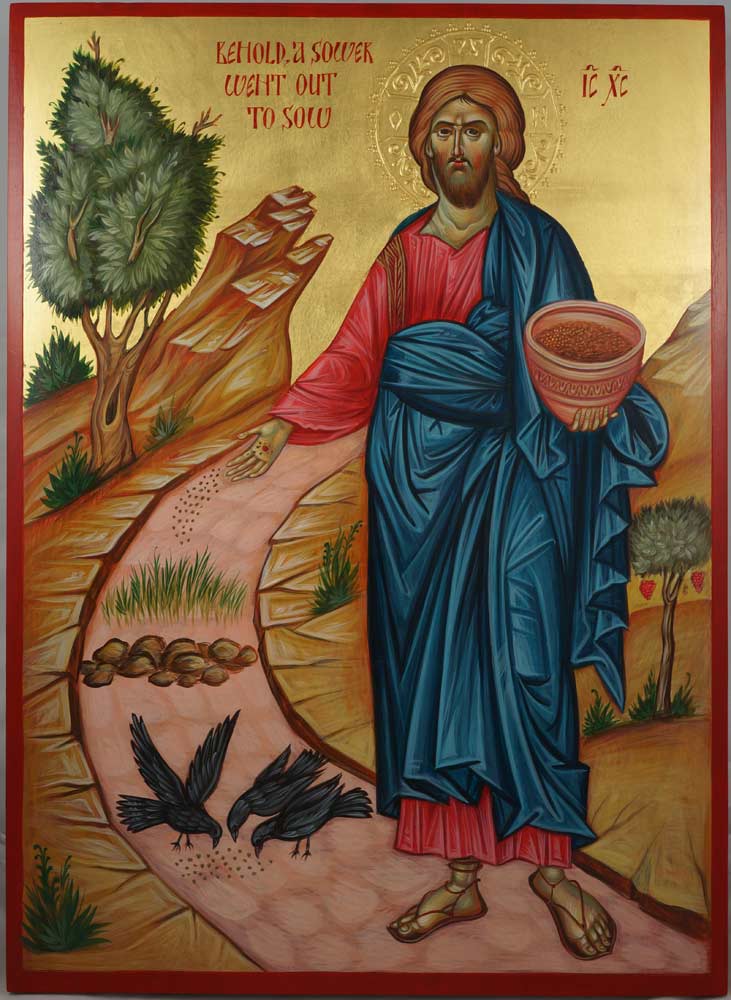
In the parable, “A sower went out to sow.”Now either this sower is foolish, or he knows something that we don’t know. If you were driving down a paved road and came up behind a farmer driving his tractor and drill, dropping seed for miles onto the asphalt, you’d be concerned. Doesn’t he know that he’s wasting his time, energy and money, in addition to ruining his drill?
But the sower in Jesus’ parable acts in a similar way: “… as he sowed, some seed fell on the path, and birds came and ate it up.” Later in the same chapter of Matthew, Jesus explains “the parable of the sower. The seed sown on the path is the one who hears the word of the kingdom without understanding it, and the evil one comes and steals away what was sown in his heart.”
This is the first of four illustrations that Jesus paints in today’s parable. The first three illustrations are pictures of the sower laboring in vain, because of the path, rocky ground, and thorns. Only the fourth illustration describes seed falling on rich soil, producing fruit, a hundred or sixty or thirtyfold.
Sowing on the path illustrates ignorance. In other words, this fruitless endeavor describes what happens when we lack the understanding that the Word of God reveals.
By contrast, to grow in humility requires a two-fold knowledge: that is, knowledge of God, and self-knowledge.
Knowledge of God is simple, because God is simple. God is Love. The Church recently, on Trinity Sunday, reflected on the mystery of the God who is divine Love. This reflection, of course, is meant to be like that of a mirror, not only a reflection upon one whom we adore. We reflect upon God as love because we, as His adopted children, are to be like Him, and so are meant to see ourselves in His reflection. That leads us to our need for self-knowledge.
However, self-knowledge is more complicated than knowledge of God because it has two contrasting parts. To be more specific, the fallen nature of man is divided, rather than being simple in the way that God created man “in the beginning”.
On the one hand is knowledge of oneself as a fallen person, as someone who has stumbled and fallen into the filth of one’s own actual sins. This is in addition to inheriting Original Sin, which leaves its traces even upon the baptized person.
On the other hand, there is knowledge of oneself as someone loved by God. One needs to know and reflect upon oneself as a person whom God has picked up out of sin, washed in the Blood of the Lamb, and raised to the dignity of His own child.
These three forms of knowledge, then—knowledge of God, knowledge of oneself as fallen, and knowledge of oneself as raised by God—are like three legs of a stool upon which one sits. Without any one of these three legs, one inevitably falls. But with all three, one can resemble the fourth illustration that Jesus verbally paints in Sunday’s Gospel Reading, where seed falls on rich soil and bears abundant life.
To put this in another way, we can listen to the first half of this Sunday’s Gospel Acclamation: “The seed is the word of God, Christ is the sower.” This sentence speaks of seed and sower. But we also have to consider the importance of the soil. All three of these are inter-dependent: seed, sower, and soil.
These three symbols of elements of the spiritual life represent the Word of God proclaimed, Christ the proclaimer, and the disciple who hears the proclamation and puts it into practice. For the disciple to do this requires humility, because the fallen person is constantly tempted to live life by his own lights and his own strengths, instead of depending each day on the light and truth that come only from God.
“Whoever will not receive you or listen to your words—go outside that house or town and shake the dust from your feet.”
The Scriptures and Tradition of the Church use many images to describe God. The reason for this wealth of images, of course, is the fact that God is infinite: no one image does justice to the depth and richness of God who is love. Likewise, there are many images used to describe the peoples whom, throughout salvation history, God has desired to draw to Himself. The tribes of Israel and the Mystical Body of Christ are described by varied metaphors.
However, we also have to confess that it takes many images to describe God’s People for a another, very different reason. There are so many ways in which God’s People sin, and fail to live up to the relationship to which He constantly calls us. It takes many different images and metaphors to describe the infidelity of the People of God. So it is in Hosea, as the prophet describes Israel with the image of a spouse, as well as the image of a child, capturing the ingratitude of one who fails to give thanks for the sacrifices that the father has made.
One of the metaphors that Hosea uses speaks to us especially as followers of Jesus. Offering the Lord’s prophecy to Israel, Hosea says, “Yet, though I stooped to feed my child, they did not know that I was their healer.” The “child”—in the singular—is the nation gathered together and nourished through the Law and the Prophets, yet the Lord recognizes that “they”—all of them—were unfaithful to Him.
Even more so did our Heavenly Father offer His own divine Son for the sake of His people, only to be met with rejection. The sacrifice of Christ Jesus is both healing and nourishment for the People of God. This is an important reason to prepare for Holy Mass with great devotion: spending time in private prayer and devotion, considering how many joys and sorrows we have to offer to God, that we might be both strengthened and healed.
“Go rather to the lost sheep of the house of Israel.”
Today’s Gospel passage speaks about reaching out to those who are hurt and sick. We hear Jesus sending his twelve apostles to go out and heal “every disease and every illness.” More than just a prophet, Jesus has authority not only to call back the repentant to Himself, but also to heal them.
When Jesus sends the apostles, His instructions are for them to go to “the lost sheep of the House of Israel”. In our own day, there are many fallen-away Catholics, and of course we pray for them. But we can do more for them than just pray. With the sort of love that Jesus held in His Sacred Heart when He looked at the crowds and said, “the harvest is abundant, but the laborers are few”, we can reach out to those who have fallen away from the Church.
We can offer gentle instructions to those who don’t know how to start again to live the Faith: to begin again to receive the sacraments, the gifts of grace which come to us through the apostles and their successors. It’s the bishops’ responsibility—and the responsibility of those priests who work under their bishops—to bring lost sheep back into the fold through the sacraments. But often, it will be ordinary Christians who point those lost sheep in the right direction.
“The harvest is abundant but the laborers are few ….”
The cry that we hear Jesus utter in today’s Gospel passage—“the harvest is abundant, but the laborers are few”—is one that we usually associate with the need for vocations in the Church. But Jesus also speaks through these words about the harvest of one’s heart and the fruits of one’s soul. In each person is a soul created by God, and each soul is capable of being completely filled, as much as it is able: that is, to be “perfected” by God’s grace.
Unfortunately, this “harvest of the soul” is neglected by so many of us by our actions and our inaction. We are not willing to believe what the Church teaches about God calling every human person to be a saint. The Church at the Second Vatican Council spoke strongly about the “universal call to holiness”.
God gives each one of us many gifts, but only when we talk with God and are strengthened by Him do we learn how to use those gifts correctly, in accord with His plan. Through our prayer, and God’s grace, our minds and wills can be formed, so that we can be more perfectly the saints God wants us to be.



 Reflections on the Sacred Liturgy