The Seventeenth Sunday in Ordinary Time [A]

The Seventeenth Sunday in Ordinary Time [A]
I Kings 3:5,7-12  +  Romans 8:28-30  +  Matthew 13:44-52

… all things work for good for those who love God, who are called according to His purpose. 

references to the Catechism of the Catholic Church cited for this Sunday by the Vatican’s Homiletic Directory:

CCC 407: cannot ignore wound of sin in discerning human situation
CCC 1777-1785: moral decision making in rapport with God’s will
CCC 1786-1789: seeking will of God in divine law in difficult circumstances
CCC 1038-1041: separation of good and evil at Judgment
CCC 1037: God predestines no one to hell

Ten centuries before Christ, the son of David became the King of Israel.  Solomon was a young man.  He recognized his lack of experience and lack of ability to govern Israel.  Yet the Lord told Solomon that any gift he asked for would be given to him.

Solomon could have asked for absolute wealth, since with such wealth he could buy off any kingdom that got in his way.  Or he could have asked for absolute power, since then he could destroy any opposing kingdom.  He could have asked for any number of things.  He decided to ask for wisdom.

Wisdom is insight into the ultimate meaning of things.  This becomes clearer when we reflect upon the differences among wisdom, intelligence, and what we might call “smarts”.  Even computers can be smart in terms of recalling facts and calculating equations.  But intelligence transcends smartness, while a computer cannot transcend its programming.  Intelligence goes beyond what is known by means of a desire to explore the unknown.

Wisdom, however, transcends intelligence because it ponders the ultimate meaning of things.  Wisdom explores the origin, the nature, and the goal of everything that is, culminating in the contemplation of the Most Holy Trinity.  Divine wisdom is a gift of God the Holy Spirit.

It is through the power of the Holy Spirit that St. Paul’s words in today’s Second Reading ring true:  “all things work for good for those who love God, who are called according to His purpose.”   We need to recognize this purpose as God the Father’s providential will.  This divine, providential will converges in Christ.  St. Paul explains this as he continues:  “those He foreknew He also predestined to be conformed to the image of His Son, so that He might be the firstborn”.

However, before the advent of this firstborn, the Jewish Scriptures already held seven books called “Wisdom Literature”:  the Books of Job, Psalms, Proverbs, Ecclesiastes, Wisdom, Song of Songs, and Sirach.  The wisdom expressed in these books of the People of Israel was unlike the wisdom taught by many ancient cultures.  It’s also unlike the conventional wisdom according to which Western culture operates today.

The wisdom that God revealed to Israel isn’t based upon self-interest or self-promotion.  It is founded upon nothing and no one other than the Lord God Himself.  If God is part of our lives, then even if our life seems a puzzle, we have reason to hope.  It doesn’t matter if we don’t understand every piece of the puzzle.  God teaches us, over time, to move one piece of the puzzle over here, and another piece there.  Over time the picture God has had in His Mind all along emerges.

This might make divine wisdom sound rather lofty, other-worldly, and as a consequence, impractical:  good for monks and nuns, but not so for the layperson on the street.  But wisdom is not some “pie in the sky” virtue.  It’s eminently practical, especially in our world today.

When individuals live for themselves, discord grows:  first in families and then in communities and nations.  This is why St. Thomas Aquinas in his Summary of Theology ascribes the seventh beatitude—“Blessed are the peacemakers, for they shall be called the children of God”—to the Holy Spirit’s gift of Wisdom [ST II-II 45,6].  In our world today the teaching of St. Thomas on this point is sorely needed.

He notes first that a peacemaker is one who makes peace either within himself or in others.  In either case peace results from setting all matters in due order.  The highest form of order can only be seen, however, and therefore set in place, in view of divine wisdom.

Second, the reward of peacemakers is that they become children of God.  St. Thomas here quotes from this Sunday’s Second Reading.  In making peace, one shares in the likeness of God’s only-begotten Son:  or in the words of Saint Paul, one is “conformed to the image of his Son, so that he might be the firstborn among many brothers and sisters.”  This divine Son is “Wisdom Begotten”, St. Thomas points out.  On the Cross, Jesus makes peace between His Father and sinful man.  Blessed are those who are called to the Supper of this “Wisdom Begotten”.
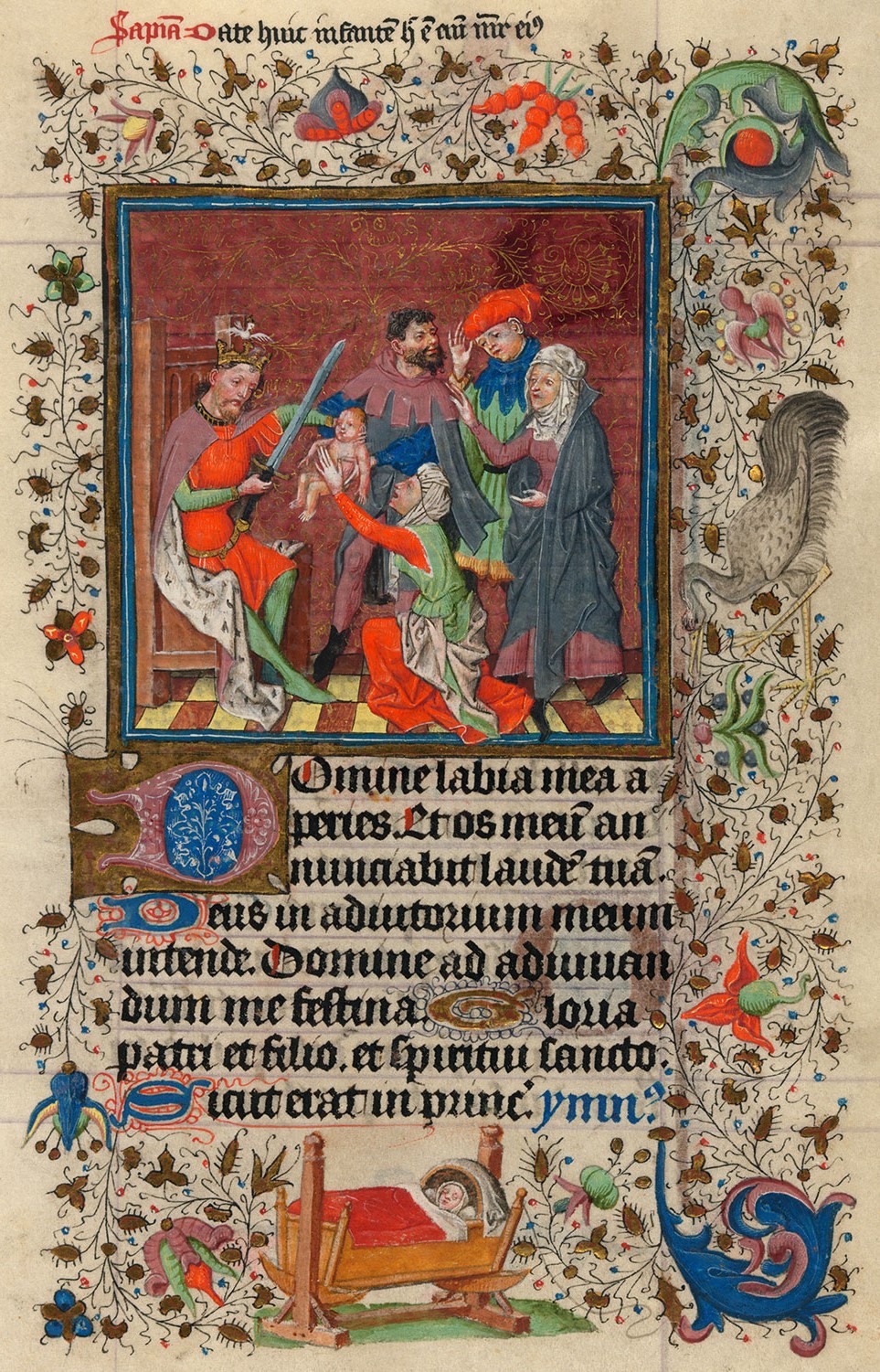
“The Judgment of Solomon” from The Hours of Catherine of Cleves (c. 1440)
The Morgan Library & Museum, MS M.917/945, p. 53

Thursday of the Sixteenth Week in Ordinary Time [II]

Thursday of the Sixteenth Week in Ordinary Time [II]
Jeremiah 2:1-3,7-8,12-13  +  Matthew 13:10-17
July 23, 2020

“‘Gross is the heart of this people ….’”

When the disciples in today’s Gospel passage ask Jesus why He speaks to “the crowd” in parables, He responds with what we might call a “theology of parables”.  Jesus contrasts the disciples with the crowd.  The disciples, He explains, have been granted “knowledge of the mysteries of the Kingdom of heaven”.  But the crowd has not.  Jesus also points out that the crowd “look but do not see” and “hear but do not listen or understand”.  So given this two-fold deficit on the part of the crowd, why is it fitting for Jesus to speak to them in parables?

Since Jesus then reveals that Isaiah 6:9-10 has been fulfilled in the midst of the crowd, parables seem to be a sort of pabulum.  By way of analogy, we might consider Saint Paul’s explanation of his own preaching to the Corinthians, who had been torn by jealousy and strife:  “I, brethren, could not address you as spiritual men, but as men of the flesh, as infants in Christ.  I fed you with milk, not solid food; for you were not ready for it; and even yet you are not ready” [1 Corinthians 3:1-2].

In other words, parables are for the weak of spirit, for those not yet ready for the full strength of the Gospel message, nor for living this message through their own lives.  Aren’t we ourselves often among their number?

OT 16-4

St. Mary Magdalene

St. Mary Magdalene
Songs 3:1-4 [or 2 Cor 5:14-17]  +  John 20:1-2,11-18
July 22, 2020

“… while it was still dark ….”

Early in the morning on the first day of the week… that is to say, in the beginning… we see Mary Magdalene huddled at the tomb weeping.  We must give her credit for this, since the apostles themselves were not faithful to the Crucified Lord in this way.  For ourselves, we pray for the grace to persevere in the midst of suffering, to allow our souls to thirst for Our Lord and God without despair in the midst of suffering.  We pray for the ability to hope during those times when we cannot see the Lord present before us.

Only in the midst of such suffering, of such weeping, of such self-emptying, can the Lord be seen clearly, as He calls us by name.  We recognize Christ, and we accept the commission He offers us.  He has news for Mary Magdalene to report:  namely, that He is ascending to His Father and our Father.  Perhaps, though, this is even more difficult:  to rejoice at someone’s return when he tells you he’s getting ready to leave you forever.

After all, on that Easter morning, who wants to hear about the Ascension?  We want to glory in the Resurrection of Our Lord Jesus Christ from the dead!  And yet that is not where Jesus points us.  Throughout His life, and in His death, he always points away from Himself toward the Father, even on the very morning of His Resurrection.

St. Mary Magdalen jacob-van-oostsanen

Tuesday of the Sixteenth Week in Ordinary Time [II]

Tuesday of the Sixteenth Week in Ordinary Time [II]
Micah 7:14-15,18-20  +  Matthew 12:46-50
July 21, 2020

“Here are my mother and my brothers.”

For at least two reasons, today’s Gospel Reading may be used (erroneously) to criticize Catholic beliefs.  The first is that Jesus seems to downplay the significance of His birth mother, Mary.  The second is that Jesus refers to His “brothers”, which seems to contradict the Church’s teaching about Mary’s perpetual virginity.  In replying to both concerns, we can not only help those with misunderstandings, but we can ourselves move closer to the heart of Jesus’ words.

First, is Jesus downplaying the significance of Mary in saying that “whoever does the will of my heavenly Father is my brother, and sister, and mother”?  On the contrary, Mary is the perfect example of what Jesus is talking about here.  It’s true that Jesus doesn’t go out of His way on this occasion (at least, as recorded by the St. Matthew the Evangelist) to point to Mary as the perfect embodiment of doing the will of God the Father.  There are several possible reasons why Jesus did not think it prudent on this occasion to highlight Mary’s human perfection, but none of these suggest that Mary is not the perfect human creature that all the Church’s Marian dogmas describe her as being.

Second, the word in today’s Gospel passage that is translated into English as “brothers” is the Greek word “adelphoi”.  Apologists have noted that other New Testament uses of this word show that the word can have meanings other than the strict sense of “siblings”.  Others have noted the logical fact that Jesus having brothers doesn’t mean that Mary had other children besides Jesus, since Jesus’ “brothers” may have been step-brothers from an earlier marriage of Joseph, who may have been a widower.  Ultimately, however, such arguments can turn Jesus’ very intention in this Gospel passage on its head:  Jesus is trying to get us to move away from worrying about His blood relations, so that you and I might be His brethren through the Church.

The Virgin Mary with the Apostles and Other Saints

Monday of the Sixteenth Week in Ordinary Time [II]

Monday of the Sixteenth Week in Ordinary Time [II]
Micah 6:1-4,6-8  +  Matthew 12:38-42
July 20, 2020

“… there is something greater than Solomon here.”

If one were to choose a saying of Our Lord from elsewhere in the Gospel to summarize today’s Gospel passage, one might choose:  “Every one to whom much is given, of him will much be required” [Luke 12:48].  A more mundane way to express Jesus’ disapproval of the request for a sign would be to say that the scribes and Pharisees don’t know what they’re asking for.  It’s dangerous to ask for a sign, because with the sign comes the responsibility to follow that sign.  Signs command us to stop, or yield, or put a limit on our speed.

At the end of today’s passage, Jesus contrasts the scribes and Pharisees with “the men of Nineveh” and “the queen of the south”.  This isn’t meant to flatter the scribes and Pharisees.  The men of Nineveh and the queen of the south were not upstanding characters.  Nonetheless, the men of Nineveh were given the sign of “the preaching of Jonah”, and they responded to the sign of the prophet by repenting.  The queen of the south was given the sign of the “wisdom of Solomon”, and she responded by coming from “the ends of the earth to hear” him.

Jesus’ bottom line puts the scribes and Pharisees in their place.  As bad as the men of Nineveh and the queen of the south were, they repented when given signs by Jonah and Solomon.  Since the scribes and Pharisees will be given a far greater sign, by one who is far greater than Jonah and Solomon (not only a prophet and king, but the divine priest as well), they will be judged by a far higher standard.  Should they not repent (as up to this point in the Gospel account they had not), the conclusion is that their culpability would be far greater.  All of this reminds each of us, a Christian who has Jesus as our Way, our Truth, and our Life, how much responsibility we bear to order our life with Christ at its center.

OT 16-1

Saturday of the Fifteenth Week in Ordinary Time [II]

Saturday of the Fifteenth Week in Ordinary Time [II]
Micah 2:1-5  +  Matthew 12:14-21
July 18, 2020

“‘… my beloved in whom I delight ….’”

The latter half of today’s Gospel passage is a quotation from the Old Testament.  St. Matthew the Evangelist cites Isaiah 42:1-4, a passage which echoes God the Father’s declaration at the Baptism of Jesus.  One way to reflect on these words—“my beloved in whom I delight….”—is to imagine God the Father addressing them to you.  Of course, that is only possible if your life is lived in Christ.  Understanding why God the Father might say these words to you demands reflecting on why the Father naturally says them to God the Son.

This quotation highlights a contrast between the Pharisees’ harsh opposition to Jesus and the delight God the Father takes in His servant and Son.  One of the causes of the Pharisees’ opposition is Jesus serving both the Gentiles and the Jews.  The first sentence of the quoted passage has God the Father speaking of Jesus (as the quote is applied by the evangelist) as His chosen servant.  However, the last sentence points to the relevance of Jesus’ service to the Gentiles.  It is the Father’s will that Jesus serve the Gentiles.

Of course, Jesus came not primarily to cure the sick, but to destroy the power of sin and death.  Part of the power of sin is the division between the Jews and Gentiles.  It is the power of the Spirit whom the Father “places upon” Jesus that can reconcile the races and nations of the earth.

OT 15-6 YEAR 2

Friday of the Fifteenth Week in Ordinary Time [II]

Friday of the Fifteenth Week in Ordinary Time [II]
Isaiah 38:1-6,21-22,7-8  +  Matthew 12:1-8
July 17, 2020

“For the Son of Man is Lord of the sabbath.”

The “something greater than the temple” of which Jesus speaks today is, of course, Jesus Himself.  As the Old Testament priests served in the Temple, so the disciples of Jesus serve in His Presence.  It is in serving Him, and especially in offering priestly sacrifice through Him, that all Christian works find their meaning and are rightly ordered.

Here the virtue of prudence shows its place.  Prudence is sometimes called the “charioteer of the virtues”.  A modern analogy would be to see prudence as the steering wheel of a car.  Prudence is neither the engine (which could be correlated with divine charity) nor the gearshift (temperance) nor the GPS (hope).  Nonetheless, as simple as the role of the steering wheel is, the whole vehicle depends essentially upon it.  Likewise with prudence.

The most basic level of moral decision-making is to shun evil and to do good.  Prudence is hardly needed at this level.  But the upper echelons of morality depend greatly on prudence, where the moral agent faces many good choices, and is tasked with choosing not merely the good but the best.  If we realize that Christ—that “something greater”—is always with us, then His Presence will guide our prudent choices.

OT 15-5 YEAR 2

The Sixteenth Sunday in Ordinary Time [A]

The Sixteenth Sunday in Ordinary Time [A]
Wisdom 12:13,16-19  +  Romans 8:26-27  +  Matthew 13:24-43

“Explain to us the parable of the weeds in the field.”

references to the Catechism of the Catholic Church cited for this Sunday by the Vatican’s Homiletic Directory:

CCC 543-550: the Kingdom of God
CCC 309-314: God’s goodness and the scandal of evil
CCC 825, 827: weeds and seed of Gospel in everyone and in the Church
CCC 1425-1429: need for ongoing conversion
CCC 2630: prayer of petition voiced profoundly by the Holy Spirit

One day a sidewalk preacher proclaimed the Good News to passersby.  Most kept walking.  One fellow, however, listened to him preach for a few minutes.  At a strategic moment, the preacher paused and then said, “Brother, why don’t you join us Sunday at my church?”  The fellow scowled and growled, “Not a chance:  your church is full of hypocrites.”  The preacher replied, “Don’t worry yourself about that.  We can always make room for one more!”

Weeds and wheat are everywhere.  Jesus’ first parable in Sunday’s Gospel Reading can help you sort through the weeds and wheat.  Like the grain of wheat, this parable can bear much fruit.

Saint Augustine of Hippo wrote one of his three greatest works—On the City of God—on this parable’s theme.  St. Augustine shows how complex and messy the world can be as weeds and wheat grow together in the same field.

St. Augustine’s masterpiece is actually a contrast between “the city of God” and “the city of man”.  This contrast is similar to the parable’s consideration of the wheat and the weeds.  But it’s not that Heaven is the City of God while earth is the City of Man:  that would be a contrast that condemns this world in which we live.  Nor is the Church the City of God while the state is the City of Man:  that would be a contrast that presents the Church as flawless.

In the 21st century, the Church lives in a precarious setting.  Not only are foundational moral truths being attacked by Western society.  The Church herself is at pains to preach the fullness of Christ’s moral teaching.  This difficulty stems in part from her credibility being diminished by the scandalous actions of some of her leaders.  Mindful of this two-fold attack—from without and from within—we can consider Jesus’ parable.

We have to start with a question like the one raised by St. Augustine’s masterpiece.  Who exactly are the weeds and who are the wheat?  At the end of the long form of Sunday’s Gospel Reading, Jesus explains the parable:  “the good seed” are “the children of the kingdom”, while the “weeds are the children of the evil one”.  But how are we practically to apply this explanation to our own day?

Perhaps another saying from our Lord could help us.  “You hypocrite, first take the log out of your own eye, and then you will see clearly to take out the speck that is in your brother’s eye” [Luke 6:42].  In other words, in seeking to apply the parable of the weeds and the wheat to our experiences today, each of us ought first to apply the parable to his or her own soul.  After we start with the real weeds in our own souls, we can move on to consider the weeds elsewhere:  in one’s family, parish, country, world, and even the Church.

Short of the Blessed Virgin Mary, there is no disciple without weeds in his soul.  In your case as in mine, then, the parable first of all describes the tension within the individual Christian’s spiritual life.  You are a “child of the kingdom” by the grace of God, beginning on the day of your baptism.  Yet you are also a “child of the evil one” by your sins:  actions, thoughts, and words, done and left undone.

Between the day of your baptism and the day of your death, you are free to cultivate your spiritual life.  You are free to break up the hard soil of your soul through acts of penance and humility.  You are free to soak the soil with tears of repentance and the Blood of Christ.

Yet you must also be patient, like the parable’s householder, who is God our Father.  For you are free also to sin in this life, allowing weeds to proliferate in your soul.  God, in His paternal love, does not force anyone to reform his life.

Jesus’ first parable in Sunday’s Gospel passage lets us focus upon three of the times that God, in His providential and merciful love, judges the human person.  The first is when we present ourselves for judgment in Confession, the second is at the hour of our death, and the third is at the Last Judgment.

In his loving judgment, God—if you will—sifts the dead similar to the parable’s description of sifting.  This parable highlights the importance of human free will, and its consequences.  In the end, however, even more important is God’s free will, by which He offers forgiveness, redemption, and sanctification.

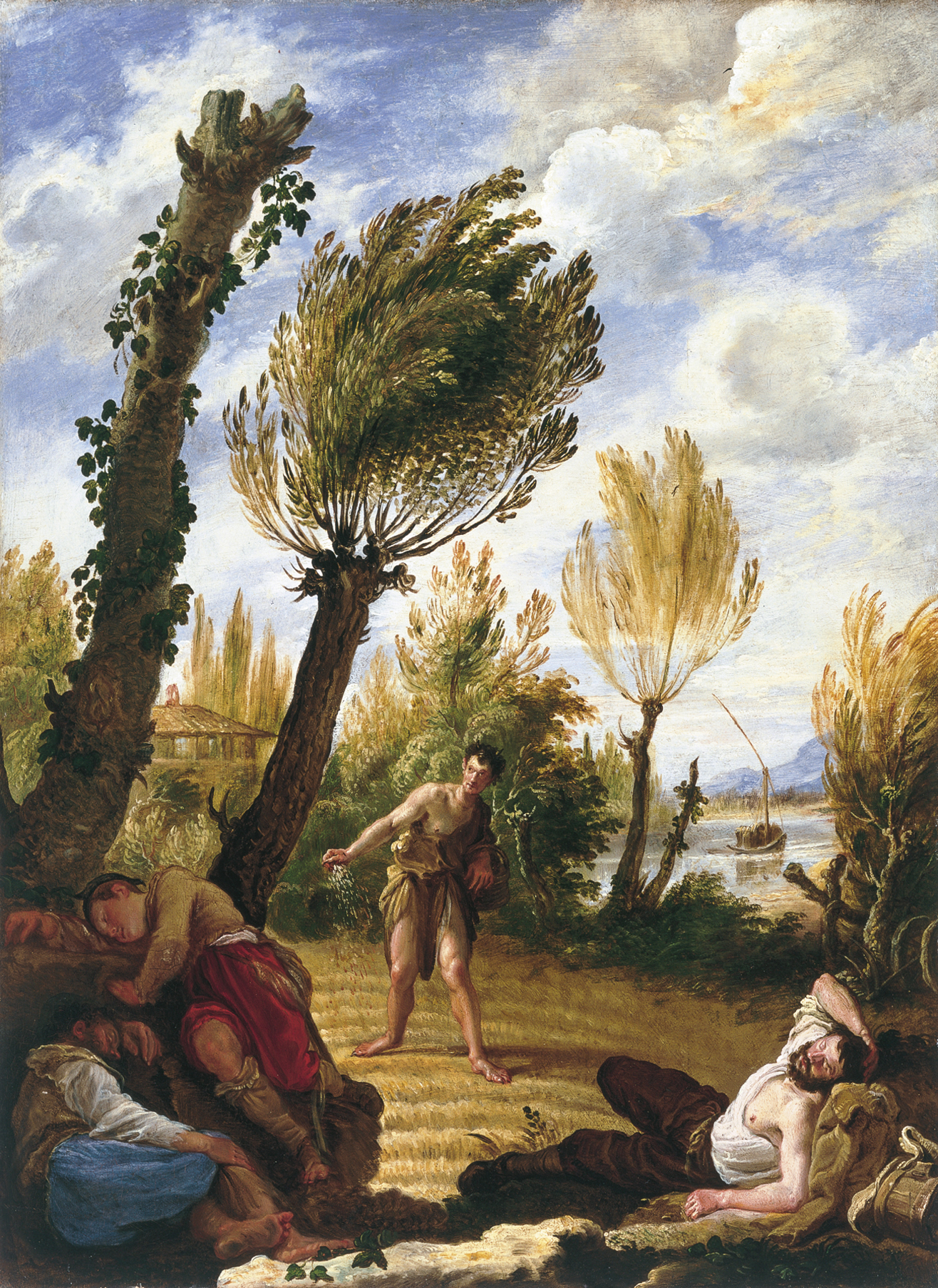
The Parable of the Tares by Domenico Fetti (1589-1623)

Our Lady of Mount Carmel

Our Lady of Mount Carmel
Zechariah 2:14-17  +  Matthew 12:46-50

“Here are my mother and my brothers.”

The Blessed Virgin Mary has many feasts throughout the course of the year.  Some honor events in her life:  for example, her Immaculate Conception on December 8, her birth on September 8, her Assumption on August 15, and her Coronation on August 22.

Other feasts of Our Lady honor her under various titles that she holds.  Many of these titles come from places throughout the world where she has appeared to the faithful:  for example, Our Lady of Lourdes, Our Lady of Fatima, and Our Lady of Guadalupe.

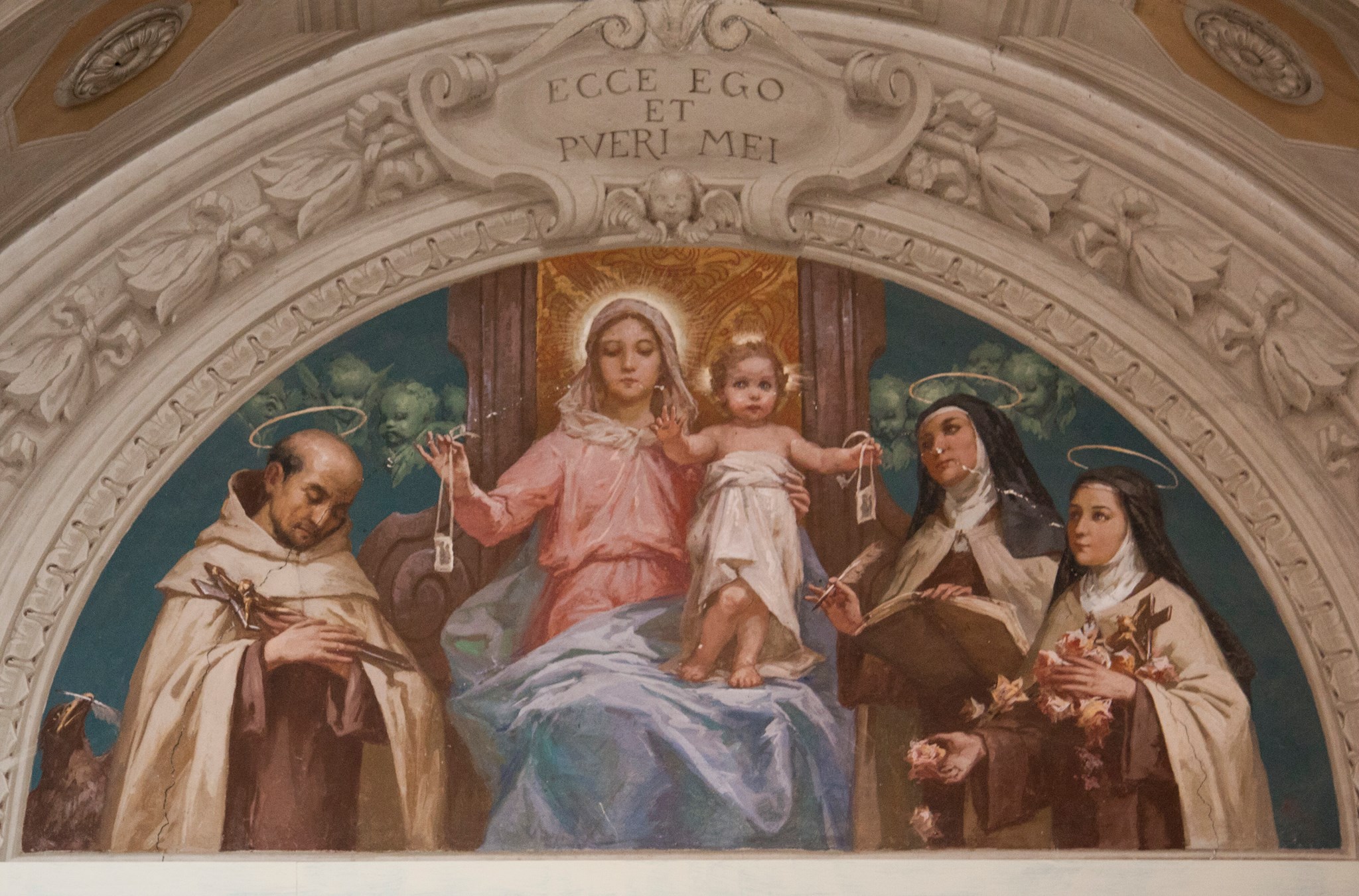
Today’s feast is different.  Today’s feast honors Our Lady of Mount Carmel.  Mount Carmel is a mountain in northern Israel, on which, in the late 12th century, Christian hermits began to live.  In time, these hermits formed a religious order known today as the “Carmelites”.  The rule—which is to say, the order of life—of the Carmelites fosters devotion to the Blessed Virgin Mary under the title of Our Lady of Mount Carmel.

Each major religious order within the Church—for example, the Dominicans, the Franciscans, and the Benedictines—has its own unique approach to Christian spirituality.  Each of these approaches holds to the essentials of Christian spirituality, but each differs in ways similar to how different children within a family develop different personalities and temperaments, even though they all have the same parents.

One might say that Carmelite spirituality is best understood by means of the greatest saints of the Carmelite order.  Three Carmelite saints stand out:  St. Teresa of Avila, St. John of the Cross, and St. Thérèse the Little Flower.  Both the writings of these saints as well as their biographies—that is, their living out the Carmelite understanding of the Gospel—helps us understand Carmelite spirituality.  On our parish website I posted a playlist of videos made by Carmelite friars about Carmelite spirituality.  I hope that you’ll watch one of more of these.  I hope that our parish family will grow in devotion to Our Lady of Mount Carmel.

The Hebrew word “Carmel” literally means “garden of God”.  Carmelite spirituality helps us cultivate our soul the way that a gardener cultivates the earth.  Rain comes down from Heaven to allow seeds to blossom.  Likewise, God’s grace from Heaven nurtures the soul, and the Christian in turn cultivates the life of Christ within the Christian soul.

St. John Paul II, in a 2001 letter to the Carmelite family wrote some words for you to reflect upon throughout this blessed feast day:

“Contemplation of the Virgin presents her to us as a loving Mother who sees her Son growing up in Nazareth, follows him on the roads of Palestine, helps him at the wedding at Cana and, at the foot of the Cross, becomes the Mother associated with his offering and given to all people when Jesus himself entrusts her to his beloved disciple.  As Mother of the Church, the Blessed Virgin is one with the disciples in ‘constant prayer’; as the new Woman who anticipates in herself what will one day come to pass for us all in the full enjoyment of Trinitarian life, she is taken up into heaven from where she spreads the protective mantle of her mercy over her children on their pilgrimage to the holy mountain of glory” [St. John Paul II, Message to the Carmelite Family, March 25, 2001; 3.]

Click HERE for a PDF copy of the Novena to Our Lady of Mount Carmel and the Litany of Our Lady of Mount Carmel.