Thursday of the Ninth Week in Ordinary Time [II]

Thursday of the Ninth Week in Ordinary Time [II]
2 Timothy 2:8-15  +  Mark 12:28-34
June 4, 2020

“There is no other commandment greater than these.”

In in the Mystery of the Word made Flesh, God makes clear to us—in the flesh—not only His divine nature.  In His human life, God the Son makes clear to us the meaning of the Law of ancient Israel.  In the person of Christ Jesus, we learn how to fulfill the great teaching given our fathers in faith.

In particular, if we listen carefully to Our Lord’s summary of the Torah in today’s Gospel passage, we notice that as there are two natures—divine and human—in the one person of Jesus Christ, so these two commands form one single commandment.

Love, quite obviously, is the common denominator between these two commands:  “Love the Lord completely,” and “Love your neighbor as yourself.”  Understanding these two as one means having Christ at the center of our entire spiritual focus:  seeing in Christ our neighbor, and seeing in Christ our Lord and God.  So we are to love others as Christ loved us from the Cross.

However, we must even go one step further.  We are to love others so that others will love as Christ has loved us.  Not merely are we to give our lives for others.  We are so to have an effect on others that they in turn will do the same.  But how is this possible?  We cannot control the decisions of others.  Even if we love them they may hate us in turn.  Yet God’s grace makes all things possible.

OT 09-4

St. Charles Lwanga & Comp., Martyrs

St. Charles Lwanga & Comp., Martyrs
2 Timothy 1:1-3,6-12  +  Mark 12:18-27
June 3, 2020

“He is not God of the dead but of the living.”

In today’s Gospel passage, Our Lord tries to make clear to the Sadducees the meaning of the Resurrection.  We too, however, even if we understand and believe in both the Resurrection of Our Lord and the promise of resurrection that God offers to all who die, perhaps need to realize what type of claim the Resurrection places upon us.

To believe in the Resurrection is to believe in the future fulfillment of God’s grace.  In turn, this is to understand that the suffering of the present is as nothing compared to the future glory to be revealed in Christ Jesus.  Furthermore, this is to guard in God’s name what has been entrusted to each of us until that final Day, which for each of us is the day of one’s death.

We never find Our Lord going into great detail about the nature of the afterlife.  There are two practical reasons for this.  First, the glory which will be the reward of God’s elect is too far beyond our comprehension.  Second, our only hope for sharing in that glory is to persevere in running the race which God has set before us in the here and now.  The virtue of perseverance stirs into flame the gift of God, which each of us first received at baptism.  In this flame, each of us is purified like gold in the furnace.

OT 09-3

Tuesday of the Ninth Week in Ordinary Time [II]

Tuesday of the Ninth Week in Ordinary Time [II]
2 Peter 3:12-15,17-18  +  Mark 12:13-17
June 2, 2020

“Repay to Caesar what belongs to Caesar and to God what belongs to God.”

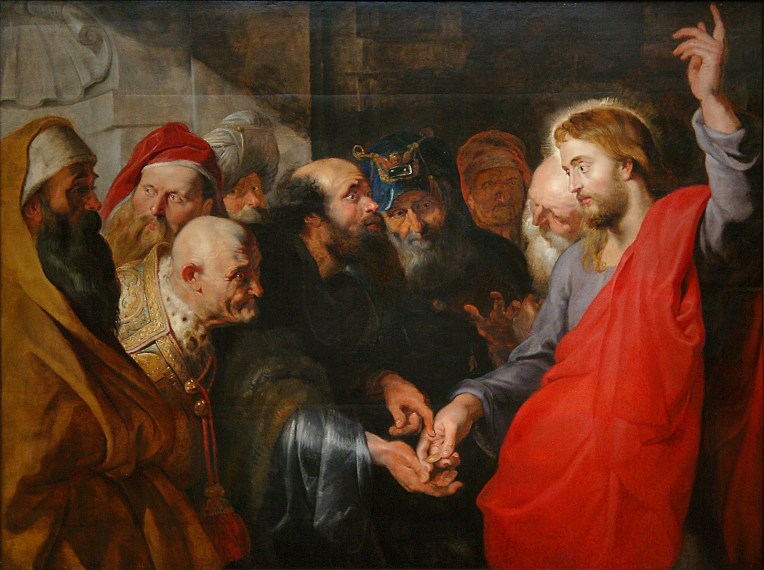
Jesus trips up the Pharisees and Herodians in today’s Gospel passage because of a dichotomy in their thinking.  They easily recognize the image of Caesar, but fail to see two even more clear images.  Focus on the first.

They fail to see Jesus as the divine Image of God the Father:  in other words, they don’t recognize Jesus’ divinity.  In addressing Jesus they say, “Teacher, we know that you are a truthful man”.  Then they assert of him, “You do not regard a person’s status but teach the way of God in accordance with the truth.”  In both statements they speak of Jesus in regard to truth (he is a truthful man and he teaches the way of God in accord with the truth) without recognizing that Jesus, as the divine Image of the Father, is the Truth made flesh.

We might be willing to pardon this, as most in the Gospel fail to see Jesus’ divinity, either (at least before His Resurrection).  This failure is at the heart of the drama in the Gospel, and reaches a climax on Calvary with Jesus’ cry:  “Father, forgive them, for they know not what they do”  [Luke 23:34].

OT 09-2