St. Charles Borromeo, Bishop

St. Charles Borromeo, Bishop
Romans 11:29-36  +  Luke 14:12-14
November 4, 2019

   “For you will be repaid at the resurrection of the righteous.”   

Although Jesus’ words today take the form of a command (“do not invite…”) to us as His disciples, we can reflect today on His words through a process of inversion.  That is, we can consider ourselves as those invited to a banquet.  The one inviting us is the Lord Jesus.  The banquet is the sacramental celebration of the Last Supper:  the Holy Sacrifice of the Mass.

Shortly before the distribution of Holy Communion, the priest—holding aloft the Sacred Host—proclaims that “[b]lessed are those called to the supper of the Lamb.”  The response of the faithful is, “Lord, I am not worthy that you should enter under my roof… .”  In this, both priest and faithful gaze on the One who has called us to Him.  We are “the poor, the crippled, the lame, the blind” of whom Jesus speaks in today’s Gospel passage.

For God Himself, of course, it’s not that He will be blessed because of our inability to repay Him.  It is from the Lord’s own divine goodness—eternal and infinite—that He bestows on us the blessing on being called to the banquet of the Eucharist.  Although we are unable to repay the Lord “in kind” for this invitation, we can nonetheless repay Him with our lives:  with the self-gift of our own body and blood, soul and humanity as Jesus’ disciples.

St. Charles Borromeo - José Salomé Pina

The Thirty-First Sunday in Ordinary Time [C]

The Thirty-First Sunday in Ordinary Time [C]
Wisdom 11:22—12:2  +  2 Thessalonians 1:11—2:2  +  Luke 19:1-10

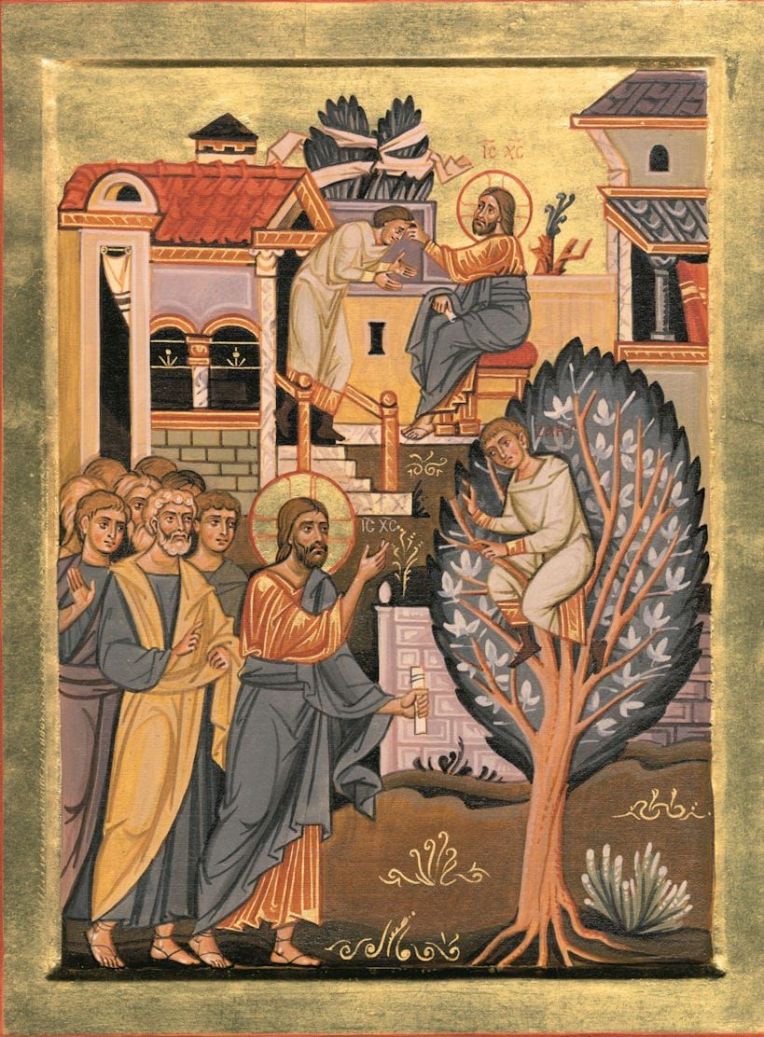
   So he ran ahead and climbed a sycamore tree in order to see Jesus….   

Out of the 52 Sundays of the Church year, more than thirty are Sundays in Ordinary Time.  When we reach these “Thirty-something” weeks, the Church’s liturgical year is drawing to a close.  During these final weeks, the Church focuses on what are called “the Last Things”:  that is, realities commonly associated with the end of the world.  The Last Things are Heaven, Hell, death and judgment.

Nonetheless, the Gospel on this 31st Sunday in Ordinary Time is not dramatic or apocalyptic.  It’s a simple story about Jesus and a fellow of short stature named Zacchaeus.  Yet the simplicity of this story helps us relate to it.  We might be impressed or even awed by dramatic stories about the end times, but it’s hard—once we return to the ordinary grind of daily life—to convince ourselves that such stories have much to do with us.  But the story about Zacchaeus is easier for us to relate to because it’s such a humble story.

Look at Zacchaeus.  He is a rich collector of taxes.  Each of us, like him, is attached to worldly things.  Zacchaeus (meaning you) wants to see who Jesus is, but Zacchaeus has two strikes against him.

The first strike against Zacchaeus is the crowd, because everyone wants to see Jesus.  It’s easy to get lost and to feel unloved when you’re in the middle of a crowd.  You might ask, “How can Jesus love everyone?”  The second strike against Zacchaeus is his small size, which may represent the size of our souls.  You might feel unworthy of God’s love and ask, “How could Jesus love me, as small as I am?”

That’s why Zacchaeus climbs up into a sycamore tree to see Jesus.  This is all Zacchaeus wants:  simply to see Jesus.  But that’s not enough for Jesus.  This reveals to us an important point about the spiritual life.  God always wants more for us than we want for ourselves.  The question, then, is whether we’re willing to do what’s needed to accept what God wants for us.

This brings us to the turning point in Sunday’s Gospel passage.  When Jesus reached the place where Zacchaeus had climbed the tree, Jesus looked up and said, “Zacchaeus, come down quickly; for today I must stay at your house.”  Jesus takes the initiative to reach out to this individual.  Likewise, just as he reached out to this little sinner, he is trying to reach into your life.

This passage illustrates the point and purpose of the spiritual life:  that God would dwell within us, and from within, transform us.  This is the point of listening to God in the Liturgy of the Word at Holy Mass:  to come down from our self-regard and allow Jesus to enter our home—to enter our soul—in order to transform us from within through the grace of the Eucharist in Holy Communion.

In the last sentence of today’s Gospel passage, Jesus offers Zacchaeus hope.  Zacchaeus knew that he was coming up short in life, but he didn’t know if Jesus would offer him what he was lacking.  Jesus responds by declaring, “the Son of Man has come to seek and to save what was lost.”
OT 31-0C

The Commemoration of All Souls

The Commemoration of All Souls
Wis 3:1-9  +  Rom 5:5-11  +  Jn 6:37-40
November 2, 2019

   The souls of the just are in the hand of God.   

The belief the Church celebrates today is part of the “communion of saints”.  That’s a familiar phrase—we recite it in the Apostles’ Creed—but the “communion of saints” isn’t just those who are canonized saints in Heaven, but also the members of the Church who are in Purgatory, as well as those on earth.  Today we who are members of that third group pray for those in the second, so that joined through prayer, we all may become members of the first.

Sometimes we feel torn like Saint Paul.  While it’s better to be in heaven, God wants us here on earth for His purposes.  Those purposes call each of us to help others in many ways.  One of the most important of these is prayer for others, which is formally called “intercession”.

Even in heaven, saints are given missions by God.  Saints are not simply fixed on God, without regard for others.  Saints in heaven pray for the rest of the “communion of saints”.

We on earth are like the saints in Heaven in this regard.  While we might want to fix our attention on God alone, God wants us to offer our lives for others, because this is often where we find God revealed in our lives.  So it is through our prayers of intercession, both for fellow pilgrims on earth, and for those in Purgatory.

Does this take away from God?  No.  God wants us to turn to each other.  Intercessory prayer is a form of Jesus’ command to “love your neighbor as yourself”.  If it’s valid in God’s eyes to pray for oneself, why wouldn’t it be to pray for others?  When a family suffers a tragedy, they draw closer together.  Part of this occurs through prayer, and they all are stronger afterwards, and more closely knit together.

Our prayer for others draws us closer to those we pray for.  Those in Heaven, in Purgatory, and on earth are drawn closer together through intercession.  When we intercede for another—or ask someone’s intercession—we don’t believe that that person is God.  We ask another to take our prayers to God.  When we call our mother and ask her to pray for us, we’re doing the same as when we kneel and pray a rosary:  we are asking our mother to pray to God for us.

Through all prayers of devout intercession, the Body of Christ grows stronger.  In the person of Christ, God and man are united.  Within Christ, we live as members of his Body.  Within Christ, we build others up, and so find God’s love for us.

Harrowing of Hell woodcut