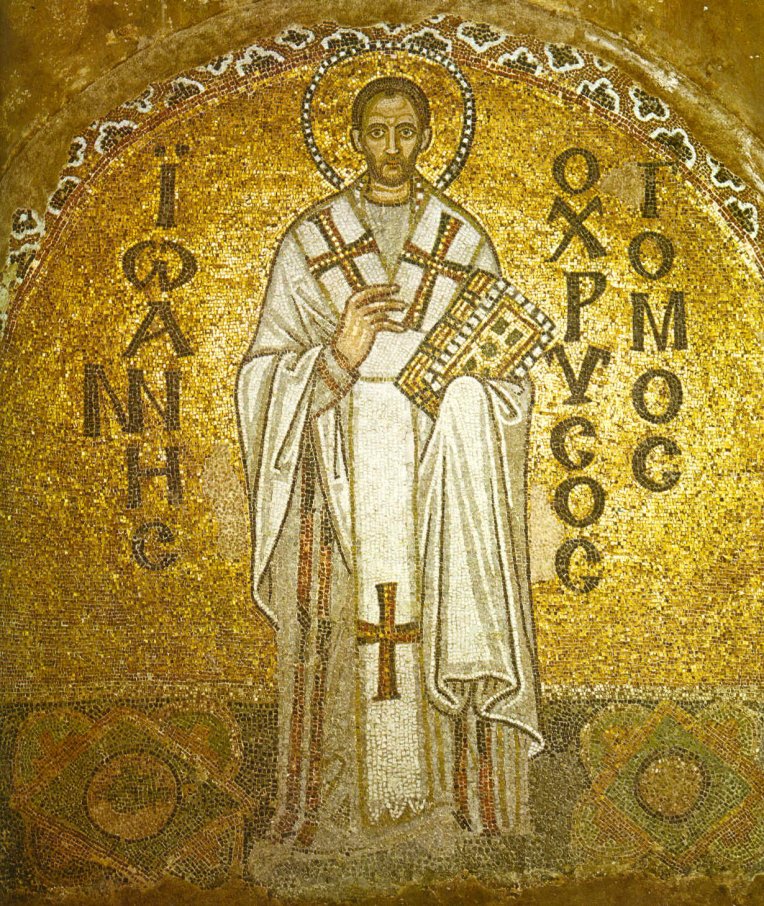
St. John Chrysostom, Bishop & Doctor of the Church

St. John Chrysostom, Bishop & Doctor of the Church
1 Timothy 1:1-2,12-14  +  Luke 6:39-42
September 13, 2019

   “Remove the wooden beam from your eye first….”   

When you make your nightly examination of conscience, and prepare monthly for the Sacrament of Reconciliation, there’s a simple way to recollect yourself for the needed self-scrutiny.  After all, if it’s been a long day or month, we can feel overwhelmed and unsure how to assess our efforts to live (or our failures to live) in Christ.

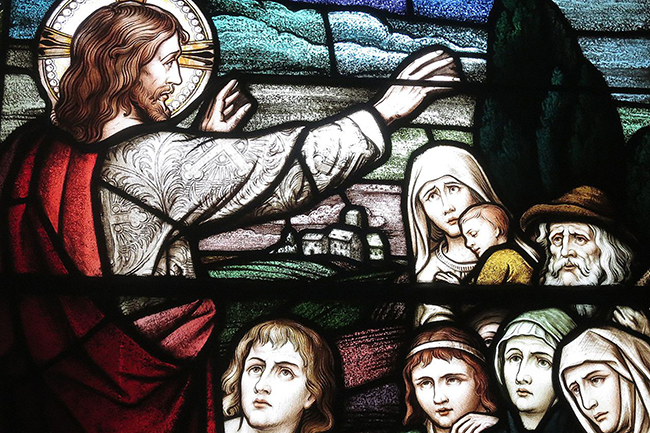
This simple means is to recall that all the commandments of the spiritual life converge in Jesus Christ.  What does this mean?  Today’s Gospel passage offers a concrete example.  The imagery with which Jesus preaches today seems only to be about the challenge of loving our neighbor:  specifically, a sinful (“blind”) neighbor.  But the two great commands of Jesus—to love God fully, and to love our neighbor as our self—converge in Him.

We are not to look down on our sinful brother, but rather to look up to him.  This is possible because of our authentic need for humility.  Christian humility is in one sense nothing more than honesty.  Both my brother and I are sinners.  We are equal in this.  But Jesus calls me to serve as brother as if I were serving Jesus Himself.  For this reason, from my state of sinfulness, I look up to my sinful brother.  From this stance, I may help him remove the splinter from his eye.  Jesus, of course, never sinned, but He did “become sin”—in the phrase of St. Paul—so that in my sinful brother I can see the Jesus whom I am to serve.

St. John Chrysostom

St. John Chrysostom
Bishop & Doctor of the Church

Thursday of the 23rd Week in Ordinary Time [I]

Thursday of the 23rd Week in Ordinary Time [I]
Colossians 3:12-17  +  Luke 6:27-38
September 12, 2019

   “Do to others as you would have them do to you.”    

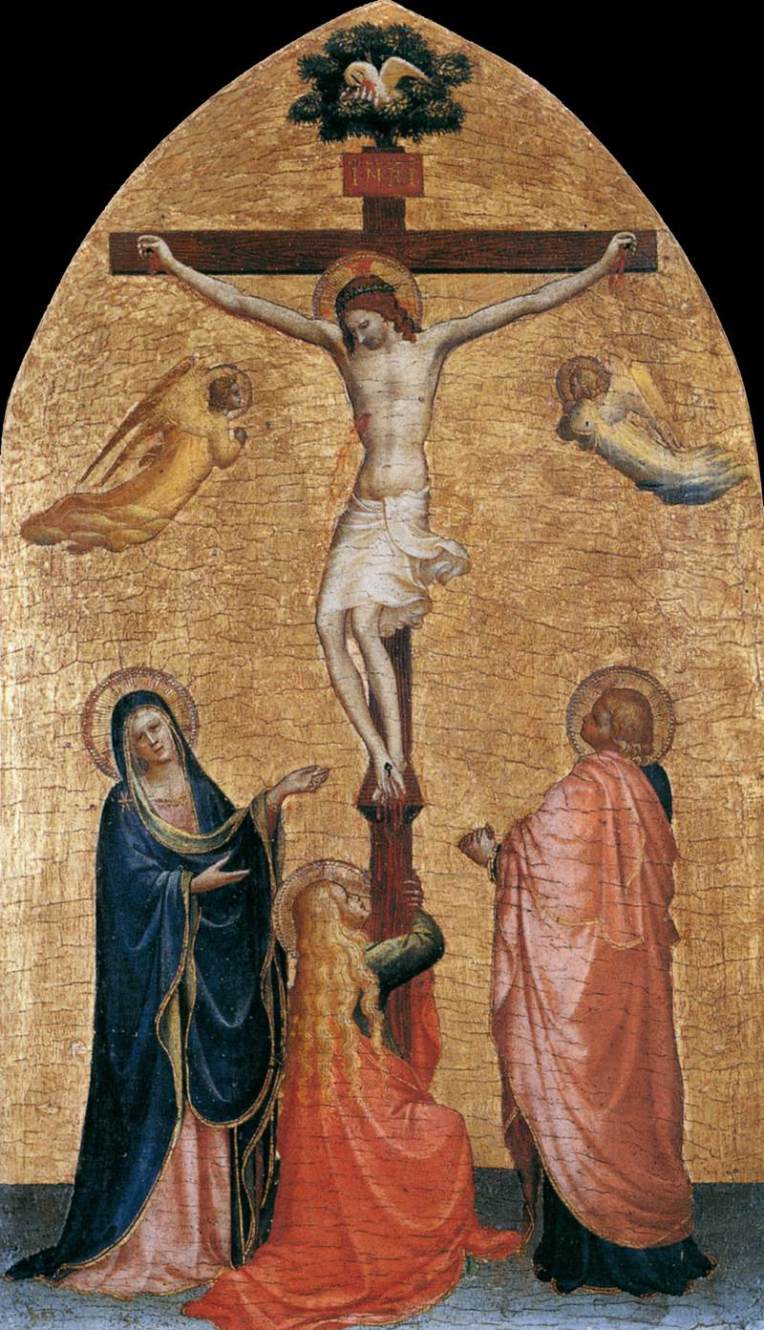
In today’s Gospel passage Jesus bids us to follow the Golden Rule.  “Do to others as you would have them do to you.”  The Golden Rule is heard within the setting of admonitions by which Jesus leads us to share in His Cross:  “Love your enemies.”  “Do good to those who hate you.”  “Pray for those who mistreat you.”  These admonitions are examples of living out on the moral and spiritual planes what Jesus accomplished on the Cross.

We all know that it’s very hard to live out these admonitions.  But it’s good to remember that Jesus is not only our teacher, who set us an example on the Cross.  He is also our Savior, who from the Cross on Good Friday bestows grace upon all who beseech Him as they strive to imitate Him.

In the final part of today’s Gospel passage Jesus offers us some rhetorical questions.  The first is representative:  “If you love those who love you, what credit is that to you?”  By the questions that follow Jesus leads us to see the Face of His heavenly Father.  When we live the Golden Rule, we will be “children of the Most High”.  Finally, to sum up everything He’s been exhorting us to live, He offers a simple principle that you and I might take and repeat throughout this day whenever there is a quiet moment:  “The measure with which you measure will in return by measured out to you.”

Most Holy Name of Mary

Today is the optional memorial of the
Most Holy Name of Mary

Wednesday of the 23rd Week in Ordinary Time [I]

Wednesday of the 23rd Week in Ordinary Time [I]
Colossians 3:1-11  +  Luke 6:20-26
September 11, 2019

   “Woe to you when all speak well of you.”   

“Woe to you when all speak well of you.”  These words of Jesus seem at first hard to reconcile with the honors we confer on the canonized saints of the Church.  If we took the words of Jesus literally, then the praise given the saints would be wrong.  And what of our speaking well of Christ Himself?

But what Jesus teaches in today’s Gospel Reading—and in all the Lucan Beatitudes—is that a Christian can only find consolation in one place:  within the Holy Spirit.  None of the things which Jesus preaches against is bad.  Money, food, laughter, and praise are all good things.  The evil which distorts and perverts these good things, however, is the temptation to rest in them—to believe that these things is to be a source of happiness, rather than a blessing that flows from happiness.

It is when we root good things such as money or praise within our earthly selves that they become that source of evil that Christ is preaching against.  May the Eucharist that the Church celebrates help us to offer all our pleasures in life to God, and admit that none of them can save us from being rooted in this world.

OT 23-3

Tuesday of the 23rd Week in Ordinary Time

Tuesday of the 23rd Week in Ordinary Time
Colossians 2:6-15  +  Luke 6:12-19
September 10, 2019

   Jesus departed to the mountain to pray, and He spent the night in prayer to God.   

St. Luke the Evangelist seems to speak more about prayer than the other evangelists.  He does so both by giving us Jesus’ words about prayer, and by illustrating occasions on which Jesus prayed.  In today’s Gospel Reading we have an example of the latter.

In the example of Jesus’ prayer shown us today by the evangelist, two things stand out.  The first is that Jesus “spent the night in prayer”.  Most of us Catholics in the Western world live very spoiled lives.  We consider the making of a Holy Hour a great sacrifice on our part.  The Gospel accounts of Jesus’ life show how common it was for Jesus to spend an entire night “in vigil”.  The lives of the saints show men and women from various stations in life all taking up this practice of the Lord in order to be close to Him.

The second notable thing about Jesus’ prayer in today’s Gospel passage is that He is engaged in prayer before a significant choice.  This reveals that the choice that follows—here, the choosing of the Twelve—is a choice made together by the Father and the Son, in the unity of the Holy Spirit.  For ourselves, the choosing of the apostles shows that great sacrifices in prayer, such as vigils, ought to spent for the sake of God’s work, and not for our own personal interests.

OT 23-2

St. Peter Claver, Priest

St. Peter Claver
Colossians 1:24—2:3  +  Luke 6:6-11
September 9, 2019

   In God is my safety and my glory.   

Jesus in today’s Gospel passage (and on many other occasions during His earthly life, leading to the Cross) faced those who had turned the meaning of religion inside out.  Jesus in this passage heals the man with the withered hand, and the response of the scribes and Pharisees is to become enraged:  they discussed together what they might do to Jesus.

In this we see a similarity between Jesus’ day, and our day:  a similarity between the world of Jesus, and the world in which we live.  The world in which we live today may be much larger than Jesus’ world:  there may be more countries, and more peoples who have to speak with each other, and work to get along.  Likewise, the Church today extends throughout the world instead of consisting of a small band of disciples.

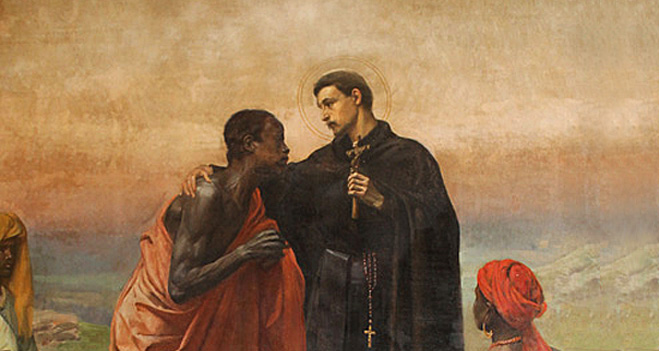
Yet there are today people, just as in Jesus’ day, who return evil for good:  whose actions make no sense.  Whether we reflect upon the example of the scribes and Pharisees in today’s Gospel passage, or Pontius Pilate, or Judas Iscariot, the question we have to ask is:  how did Jesus respond to those who hated Him, and nailed Him to the Cross?  Can we be like our Lord Jesus, even in a situation like this?

St. Peter Claver

St. Peter Claver, Priest

The 23rd Sunday in Ordinary Time [C]

The 23rd Sunday in Ordinary Time [C]
Wis 9:13-18  +  Philm 9-10,12-17  +  Lk 14:25-33
September 8, 2019

   And thus were the paths of those on earth made straight.   

Asking God for things is a tricky business.  We might even say that of all the types of Christian prayer, the prayer of petition demands the most deliberation.  Today’s First Reading addresses this challenge indirectly, asking rhetorically:  “Who can know God’s counsel, or who can conceive what the Lord intends?  For the deliberation of mortals are timid, and unsure are our plans.”  We might paraphrase these verses by asking, “When I pray, how can I get my human free will to align with God’s divine and providential will?”

So to “fine tune” our prayers in order to make them more effective, here’s a question for you.  But be careful, because it’s a trick question:  “When we petition God in prayer, should we pray for a good thing?”  The answer is “Yes… and No.”  Today’s Scripture passages explain why by giving us examples of, and by describing, the virtue of prudence.

If someone were to ask you, “Should you pray for a good thing?”, then you should answer “No!”  The definition of prudence shows us why we should not pray just for a good thing.  Notice in this definition the two tasks that prudence enables us to carry out.

The Catechism of the Catholic Church defines prudence as “the virtue that disposes practical reason to discern our true good in every circumstance, and to choose the right means of achieving it” [CCC 1806].  Prudence empowers us to do two things:  first, to see our “true good” in a given circumstance; and second, to choose the means to reach this “true good”.  So prudence guides both our intellect (in seeing the “true good”), and our will (in choosing the “true good”).  Prudence is really the most practical of all the virtues, because it guides the marriage of our intellect and will in daily life.

Nonetheless, as insightful as this definition is, it begs an important question.  What is this “true good”?

Our Scripture passages today show us how this “true good” is not just the good as opposed to the bad.  The true good is the best good, out of many good choices.

When we were little, our parents taught us to make moral choices by recognizing right from wrong; good from bad; what is holy from what is evil.  This is the first stage of moral wisdom.  This is the foundation of making moral choices.  It’s essential that we understand that difference.  In fact, to put it bluntly, this difference is the difference between Heaven and hell.  But as a Christian, you have to build upon that foundation.

The foundation of Christian morality is about good versus bad.  We build on that by hearing God call us beyond only choosing what is good.  God wants us to do far more:  He wants us to choose what is best over and above what is merely good.  It’s in this sense that God does not want you to choose a good thing:  God wants you to choose the best thing.  “Good” is not good enough.  Only “the best” is good enough for God, and for you and your vocation.

To illustrate all this, consider a particular setting in which many Christians must make tough moral choices:  parenting.  Of all the struggles that parents face—and they face many, given that their children are surrounded today by a corrupt culture—one of the harder struggles is to instill the virtue of prudence into the lives of their children.

Humility, by contrast, is far easier for children to acquire, because life itself has a way of teaching everyone humility.  All of us who are adults have learned many lessons about humility over the years:  some people call it the “school of hard knocks”.  However, the virtue of prudence doesn’t force its way into your life as humility does.

Here’s another difference between humility and prudence for parents to keep in mind.  After humility, prudence is the second-most foundational virtue.  Where humility is the mother of all the other virtues, the Catechism uses a striking image to describe prudence:  the Catechism calls prudence the “charioteer” of all the other virtues.

In other words, you can think of prudence as being the “inner ear” of the Body of Christ.  As your inner ear controls your body’s sense of balance, so prudence controls the balance of your soul, including the balance of your moral choices.  You could be the strongest football player, the most poised ballerina, or the most agile sprinter in the world.  But if that one little part of your inner ear didn’t work, then you and your strength, poise and agility would fall flat on your face.

Everyone needs a sense of balance:  not only physical balance, but even more so moral balance.  Other virtues may be more powerful and even more important, but without prudence, they won’t allow you to reach for the greatest good in life.

+     +     +

click HERE to watch Jeff Cavins’ reflection for this liturgical Sunday (5:15)

click HERE to read the homily of Monsignor Charles Pope for this Sunday

click HERE to read the homily for this Sunday from Pluscarden Abbey in Scotland

+     +     +

click HERE to read Pope Francis’ 2013 Angelus address for this Sunday

click HERE to read Pope Emeritus Benedict’s 2007 homily for this Sunday

click HERE to read St. John Paul II’s 2004 homily for this Sunday
OT 23-0C

Saturday of the 22nd Week in Ordinary Time [I]

Saturday of the 22nd Week in Ordinary Time [I]
Colossians 1:21-23  +  Luke 6:1-5
September 7, 2019

   …persevere in the faith, firmly grounded, stable, and not shifting from the hope of the Gospel….   

Following yesterday’s majestic hymn about the transcendent Christ, Saint Paul in today’s First Reading from Colossians speaks plainly to sinners.  Just as Paul addressed the Colossians as those who had been redeemed in Christ but who were—at the time of his writing—struggling to remain faithful, so we also are addressed today:  we who know very well the experience of sin, and its consequent forms of alienation.

Paul’s address to the Colossians here has two parts, focusing first on Christ and then on them.  Paul reminds the Colossians that their reconciliation was won “in the fleshly Body of Christ through His death”.

But the Colossians, for their part, must imitate Christ.  Here we ought to put ourselves in the shoes of the Colossians.  We are “holy, without blemish” if we “persevere in the faith, firmly grounded, stable, and not shifting from the hope of the Gospel”.  The key to persevering in faith, and standing fast in hope, is to live in love.  This love is ours in the person of Jesus.

OT 22-6

Friday of the 22nd Week in Ordinary Time [I]

Friday of the 22nd Week in Ordinary Time [I]
Colossians 1:15-20  +  Luke 5:33-39
September 6, 2019

   “Rather, new wine must be poured into fresh wineskins.”   

Depending on circumstances, two given cousins may resemble each other very closely, or not at all.  Today’s Gospel passage presents a contrast between Jesus and His cousin, John the Baptist.  Jesus confirms the differences between Him and John, although these differences lead in the same direction.

The context of this contrast is a complaint lodged against Jesus by the scribes and Pharisees.  They uphold the practice of fasting and prayer, but at the same time note that Jesus’ disciples don’t seem to engage in either.

Jesus responds with a metaphor and a parable.  Consider the former.  Jesus describes Himself as a bridegroom.  We as modern Christians understand that by this metaphor Jesus is referring to Himself as the bridegroom of the Church, though that part of the metaphor would have been lost on His original hearers.  But He continues by noting that when the bridegroom is taken away, then the wedding guests will fast.

The latter part of the metaphor can be applied in two ways.  The first we can reflect on in terms of Jesus’ earthly life, and the time of His Passion and death during Holy Week.  The second we can reflect on in terms of our own earthly lives as pilgrims on our way to Heaven:  that is to say, as members of the Church Militant.  We may only share fully in the wedding feast of the Lamb in Heaven, and so while still here below we fast and pray, hoping for complete union in Heaven with the Lord.

OT 22-5

Thursday of the 22nd Week in Ordinary Time [I]

Thursday of the 22nd Week in Ordinary Time [I]
Colossians 1:9-14  +  Luke 5:1-11
September 5, 2019

   “But if you say so, I will….”   

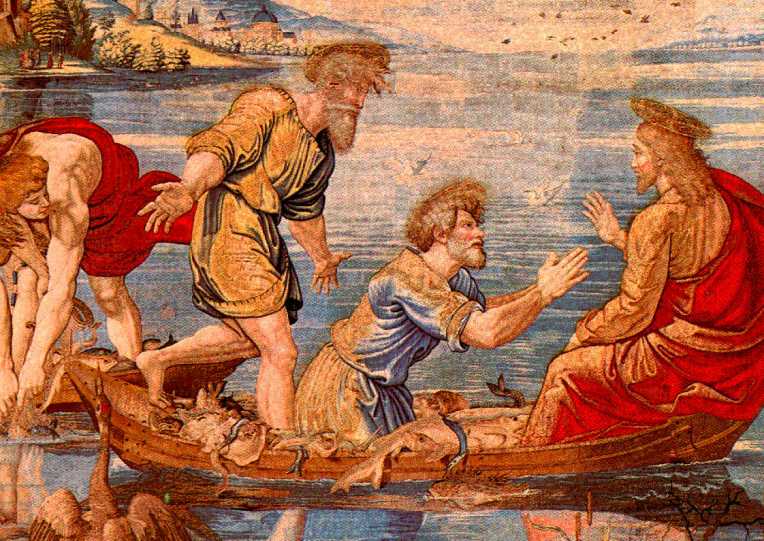
In spite of Peter’s knowledge and experience in fishing, and in spite of his having been up all night long, Peter and his fishing partners had caught absolutely nothing.  Sometimes in what we do, also, we try our best, even at things we’ve done before and know a lot about, but things don’t work out for us.  That’s a natural part of life in this fallen world.

But in today’s Gospel passage, we hear about Jesus coming along.  Jesus was a carpenter, not a fisherman.  Jesus tells Peter to put out the fishing boat into deep water (not the best place to catch fish), and after the sun had risen (not the best time).  Peter starts out with a protest against Jesus’ idea, but then has second thoughts, and replies to Jesus, “But if you say so, I will….  I will lower the nets.”

Remember that God’s ways are not our ways.  Sometimes, when we pray, we end up telling God what He should be doing.  And when we hear God talking to us, we think His ideas are bad ideas.  When Jesus asks us to do something for Him, we should listen.  And through the grace that we receive in Holy Communion, we should speak as Peter speaks, and say to Jesus, “But if you say so, I will….”

OT 22-4