The 18th Sunday in Ordinary Time [C]
Eccl 1:2;2:21-23 + Col 3:1-5,9-11 + Lk 12:13-21
August 4, 2019
“…rest, eat, drink, be merry!”
I loved to read mystery stories as a boy. The older I get, the less I think about mysteries that have solutions. A different type of mystery is more compelling: mysteries of our Faith. They’re not absolutely mysterious: that is, there are things we can know and say about them. But they have no solutions as stories do.
As an example, consider one of the mysteries that Saint Paul describes in today’s Second Reading. What is Saint Paul claiming when he tells the Colossians that they “have died”? He says: “Think of what is above, not of what is on earth. For you have died, and your life is hidden with Christ in God. When Christ your life appears, then you too will appear with Him in glory.”
Of course, St. Paul is not talking about a physical death. He’s talking, rather, about the spiritual death that marks the life of every person who follows Jesus. What does this sort of death look like?
Imagine a large stone being thrown mightily into a deep lake. The stone starts to sink upon hitting the water, and the impact causes a large splash. Then, while the stone continues to sink, smaller splashes rise and fall as the impact of stone against water ripples in wider and wider circles. This image symbolizes your Christian life.
The moment of impact is the moment of your baptism: an experience of dying into Christ. The Sacrament of Baptism is the beginning of the Christian life, and of course we should never underestimate the magnitude of the gift of Baptism. Nor should we forget that it remains a source of blessings throughout our earthly days. Nonetheless, baptism is not the end of the Christian life. Baptism makes waves by means of many smaller deaths in daily life.
One that’s neglected by many Christians in our day and age is asceticism. Asceticism is a habit of the Christian life. It’s a good habit, and so we call it a virtue of the Christian life. Asceticism is the good habit of self-denial.
To the world, this sounds like foolishness: how can denying one’s own self be good? To the world, the supreme good is to promote oneself, to inflate oneself, to indulge oneself. But the Christian looks at life differently: through the lens of baptism into Christ’s Passion, Death and Resurrection. Baptism is the pattern for the asceticism of our daily life as Christians. Jesus’ parable in today’s Gospel Reading illustrates the contrast between someone who lives for the world and someone who lives in the world but for God. In order to heed Jesus’ admonition “against all greed”, asceticism is necessary.
Every act of Christian asceticism is the freely chosen sacrifice of something good. By contrast, not doing something that’s evil is a moral imperative. We must not do what is evil. But we may do what is good… or, we may not do what is good. We are free to choose either course of action. It’s from this freedom that asceticism derives its value. To sacrifice what is good, when we have the moral freedom to enjoy it, turns something good into something better!
To repeat this in a different way: not doing something that’s intrinsically evil is commanded by God, and must not be done by every Christian, in every circumstance. But asceticism is different. Asceticism is not doing something that’s good, something that we are in fact free to do, because we want to sacrifice to God our freedom to enjoy that good.
Here’s an example: a person is always free to eat what his body expects in order to function in a healthy manner. But a person may freely choose to sacrifice this same good—that is, a healthy meal that his body expects—as an act of asceticism. Will his body perish because of his asceticism? No: Christian asceticism should never cause irreparable harm to the human person. But even an athlete, when he wants to strengthen his muscles, has to break them down first.
An authentic act of Christian asceticism has two ends. The first end regards oneself. This end or goal is to discipline one’s body and soul. One purpose is so that one becomes less attached to earthly goods.
The second and more important end, to which the first is oriented, regards God. Authentic Christian asceticism makes one more free to seek and embrace spiritual goods, even and especially when those spiritual goods come at a demanding cost.
click HERE to watch Jeff Cavins’ reflection for this liturgical Sunday (5:55)
click HERE to read the sermon of St. Augustine of Hippo on Luke 12:15
click HERE to read the reflection of Monsignor Charles Pope for this Sunday
+ + +
click HERE to read Pope Francis’ 2013 Angelus address for this Sunday
click HERE to read Pope Emeritus Benedict’s 2010 Angelus address for this Sunday
click HERE to read a General Audience address of St. John Paul II related to the Gospel Reading of this Sunday
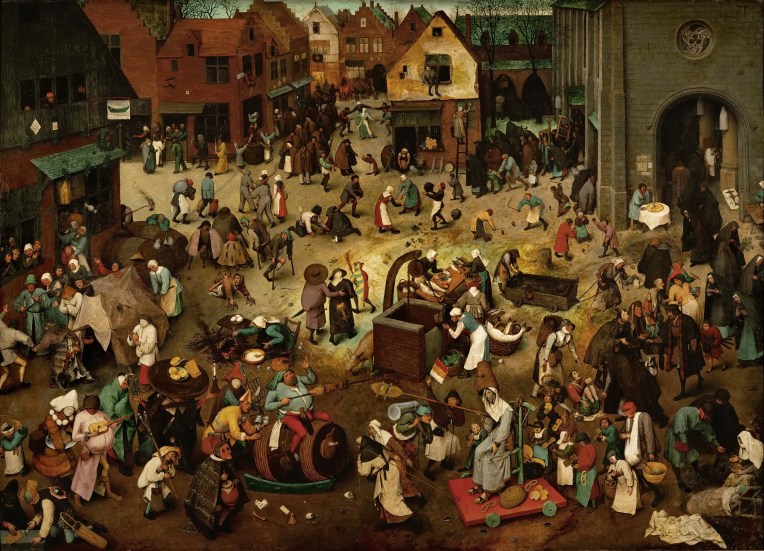
The Fight Between Carnival and Lent by Pieter Bruegel the Elder [ca. 1525-1569]
 Reflections on the Sacred Liturgy