The Nativity of the Blessed Virgin Mary

The Nativity of the Blessed Virgin Mary
Micah 5:1-4  +  Matthew 1:1-16,18-23
September 8, 2018

“She will bear a son and you are to name Him Jesus….”

As the Church today celebrates the nativity of Mary, we reflect on human nature.  In the great universities of the Church, this is the study of theological anthropology:  that is, the study of man vis-à-vis God who is man’s Creator, Redeemer and Sanctifier.  God in Himself—as Father, Son and Holy Spirit—had no need whatsoever to create man.  Nor did He have need to care for fallen man.

But God chose, and still chooses, to redeem and sanctify individuals.  He does this through Christ Jesus, who entered our world through the life of Mary.  In the field of theological anthropology, Jesus and Mary stand at the head of our prayer, reflection, and study:  Jesus as a divine Person who took on a human nature, and the Blessed Virgin Mary as the perfect human creature.

Today we hear in the Gospel about the family tree of Jesus.  There were some great figures in Jesus’ family tree, such as King David.  But most of the people in Jesus’ family were very ordinary.  Maybe the most ordinary was Mary.

That might seem strange to say, because we might want to say that Mary was the most extraordinary.  Of course, Mary was the most holy of Jesus’ ancestors:  she was the only person to come before Jesus who had never sinned.  But still, at the same time, Mary was really the most ordinary person to come before Jesus.

If you were to walk down a busy street in a large city, and Mary walked by you, you probably would never recognize her.  That’s because Mary lived out the Gospel so fully.  She lived out the Gospel even before Jesus became a human being.  It’s because Mary lived out the Gospel so completely that Jesus became a human being.  But living out the Gospel is really very simple, very quiet, and very ordinary.  It doesn’t mean being famous, or looking for attention from others, or wanting to be better than those around you.

For me to live the Gospel means living like Mary:  listening for God’s voice every day, letting his Will for my life sink into my heart, and carrying out that will with the love of my own human heart.

Friday of the 22nd Week in Ordinary Time [II]

Friday of the Twenty-second Week in Ordinary Time [II]
1 Corinthians 4:1-5  +  Luke 5:33-39
September 7, 2018

“Rather, new wine must be poured into fresh wineskins.”

Depending on circumstances, two given cousins may resemble each other very closely, or not at all.  Today’s Gospel passage presents a contrast between Jesus and His cousin, John the Baptist.  Jesus confirms the differences between Him and John, although these differences lead in the same direction.

The context of this contrast is a complaint lodged against Jesus by the scribes and Pharisees.  They uphold the practice of fasting and prayer, but at the same time note that Jesus’ disciples don’t seem to engage in either.

Jesus responds with a metaphor and a parable.  Consider the former.  Jesus describes Himself as a bridegroom.  We as modern Christians understand that by this metaphor Jesus is referring to Himself as the bridegroom of the Church, though that part of the metaphor would have been lost on His original hearers.  But He continues by noting that when the bridegroom is taken away, then the wedding guests will fast.

The latter part of the metaphor can be applied in two ways.  The first we can reflect on in terms of Jesus’ earthly life, and the time of His Passion and death during Holy Week.  The second we can reflect on in terms of our own earthly lives as pilgrims on our way to Heaven:  that is to say, as members of the Church Militant.  We may only share fully in the wedding feast of the Lamb in Heaven, and so while still here below we fast and pray, hoping for complete union in Heaven with the Lord.

Thursday of the 22nd Week in Ordinary Time [II]

Thursday of the Twenty-second Week in Ordinary Time [II]
1 Corinthians 3:18-23  +  Luke 5:1-11
September 6, 2018

“But if you say so, I will….”

In spite of Peter’s knowledge and experience in fishing, and in spite of his having been up all night long, Peter and his fishing partners had caught absolutely nothing.  Sometimes in what we do, also, we try our best, even at things we’ve done before and know a lot about, but things don’t work out for us.  That’s a natural part of life in this fallen world.

But in today’s Gospel passage, we hear about Jesus coming along.  Jesus was a carpenter, not a fisherman.  Jesus tells Peter to put out the fishing boat into deep water (not the best place to catch fish), and after the sun had risen (not the best time).  Peter starts out with a protest against Jesus’ idea, but then has second thoughts, and replies to Jesus, “But if you say so, I will….  I will lower the nets.”

Remember that God’s ways are not our ways.  Sometimes, when we pray, we end up telling God what He should be doing, and when God talks to us, we dismiss His ideas.  Instead, when Jesus asks us to do something for Him, we should listen.  Then, through the grace of His sacraments, we should speak as Peter speaks, and say to Jesus, “But if you say so, I will….”

Wednesday of the 22nd Week in Ordinary Time [II]

Wednesday of the Twenty-second Week in Ordinary Time [II]
1 Corinthians 3:1-9  +  Luke 4:38-44
September 5, 2018

At daybreak, Jesus left and went to a deserted place.

Today’s Gospel passage, as it’s divided in modern editions of the Bible, consists of three paragraphs.  As we reflect on the passage, we see a movement like the ripples in a pond.  Jesus in His desire to serve moves outwards towards more and more people:  from healing Simon’s mother-in-law, to healing those in the area “with various diseases”, to his departure for ministry in “the other towns”.

As such, we can reflect on this passage as an illustration of the “catholicity” of Jesus’ mission on earth, and so also the catholicity of His Church’s mission.  In that latter regard, we ought to reflect on ourselves—each of us—as one member of that Christ who acts in today’s Gospel passage.

Each of us rightly gives thanks and praise to Jesus for being our “personal Lord and Savior”.  But such a confession of faith should never move us to think that our Christian Faith is simply about “me and Jesus”.  Jesus is the Lord and Savior—or at least, wishes to be—of every human person who ever has, does now, or ever will live.  In turn, the salvation that Jesus offers me ought to root itself in my service to others, to bring that about.

Each of us at times might enjoy the prayerful solitude that Jesus entered in a deserted place at daybreak.  Perhaps we would prefer that solitude.  For most, though, the solitude serves our active roles within the mission of the Church.

Tuesday of the 22nd Week in Ordinary Time [II]

Tuesday of the Twenty-second Week in Ordinary Time [II]
1 Corinthians 2:10-16  +  Luke 4:31-37
September 4, 2018

…they were astonished at His teaching because He spoke with authority.

Astonishment is evoked by the fact that Jesus teaches with authority.  Why is there this astonishment, and what does it mean for Jesus to teach with authority?

In the culture that surrounds us, every person believes himself to be his own authority.  In effect, this wide-spread belief means that no real authority exists.  In our society there is a great need for clarity about the meaning and purpose of authority.

At its most literal level, the word “authority” is related to the word “author”.  The author of a novel can create worlds of his own design from his imagination.  Laws of physics need not apply.  Strange creatures can exist, and fantastic events are commonplace.  Tolkien, Baum and Roddenberry are all authors in this sense.  They have the authority to create worlds and races of creatures, and to confer life upon and take life from individuals.  However, this is merely a fictional form of authority.  In reality, there is only one Author of creation.

Jesus, as God from God and Light from Light, is this divine Author.  Through His divinity He has authority.  He exercises this authority throughout the three years of His public ministry for various persons, and for all mankind on Calvary.  However, in the face of His exercise of divine authority, astonishment arises for varied reasons.

Most cannot believe that a mere man could exercise divine authority.  Jesus, of course, was not merely a man, even though He was fully so.  In our own lives, we should not be astonished by the authority or power of Jesus.  We should root our daily lives in His desire to grant us His divine life, and all good things that we need.

St. Gregory the Great, Pope & Doctor of the Church

St. Gregory the Great, Pope & Doctor of the Church
1 Corinthians 2:1-5  +  Luke 4:16-30
September 3, 2018

…the eyes of all in the synagogue looked intently at Him.

When a Catholic man first receives the Sacrament of Holy Orders, he becomes a deacon.  One of his chief responsibilities is to preach during the Sacred Liturgy.  It’s a rare newly ordained deacon who isn’t very nervous while preaching his first homily.  We might wonder whether Jesus, in His human nature, felt nervous as He preached in the synagogue in Nazareth.  After all, if there’s one thing more nerve-wracking than preaching, it’s preaching in your hometown!

The evangelist does not divulge what Jesus felt as He preached on this occasion.  But he does relate what the congregation felt.  At first, they were “amazed at the gracious words that came from His mouth.”  But then Jesus continued to preach.

As Jesus continues, the congregation feels very differently.  They “were all filled with fury”:  not just anger, but fury.  As a point for our reflection today, we might ponder why Jesus wasn’t content with the congregation’s amazement at His graciousness.  Why did He continue preaching when He knew in His divinity what their response would be?  Why did He knowingly provoke the congregation’s fury?  Finally, what sins of theirs was their fury meant to cover, and which sins in our own lives are we so attached to that we’re willing to manifest fury rather than face them?

Homily – 22nd Sunday in Ordinary Time [B]

The Twenty-second Sunday in Ordinary Time [B]
Deut 4:1-2,6-8  +  Jas 1:17-18,21-22,27  +  Mk 7:1-8,14-15,21-23
September 2, 2018

Humbly welcome the word that has been planted in you and is able to save your souls.

This is the antidote:  this “word” that Saint James speaks about in today’s Second Reading.  He uses the image of a seed being planted as a metaphor to describe the power of God’s Word to save your soul.  This word is the antidote to the power that sin and death hold over your life.  So consider St. James’ image of the Word.  He forms this image through three sentences of the Second Reading.

St. James first explains that God the Father “willed to give us birth by the word of truth[,] that we may be a kind of firstfruits of His creatures.”  St. James is not talking about your natural birth, of course.  He’s referring to your baptism:  the day on which God adopted you as His own child.  God the Father brought about your spiritual birth through “the word of truth”.  But what is this “word of truth”?

Well, remember how Jesus described Himself in John 14:6:  “I am the way, and the truth, and the life.”  Jesus is Truth, and at the start of St. John’s Gospel account, the evangelist proclaims:  “In the beginning was the Word, and the Word was with God, and the Word was God.”  A few verses later, the evangelist professes that this same “Word became Flesh and dwelt among us”.[1]  This Word made Flesh is Jesus Christ.  This Word is “the word of truth”.  St. James is telling us that God the Father “willed to give us birth by” means of Jesus Christ, who is “the word of truth”.

So this “word of truth” is a Person, not a thing.  This word of truth is a “who”, not a “what”.  The word of truth is not abstract and theoretical, but living and calling you to Himself.  This divine Person who is the word of truth is the means—the way—by which you can enjoy eternal life.  That eternal life lasts forever in Heaven, and cannot be lost once you are there.

Nonetheless, even while you make your pilgrimage through this world, you can glimpse, and share in, that eternal life today.  St. James speaks to this when he points out that God the Father “willed to give us birth by the word of truth” for a specific reason.  That reason, St. James states, is so “that we may be a kind of firstfruits of His creatures.”

But how does that happen?  How can you be “a kind of firstfruits [among] His creatures”?  St. James goes on to give you the answer.  He exhorts you twice, and both of his exhortations involve that same “word of truth” that he’s already mentioned.

St. James exhorts you first to “[h]umbly welcome the word that has been planted in you and is able to save your” soul.  This reminds us of the Parable of the Sower.  Do you remember the sower who scattered seed on rocky ground, on a path, amidst thorns, and then also upon good soil?[2]  St. James is exhorting you to make good soil of your soul.  “Humbly welcome the word that has been planted in you and is able to save your” soul.

But how do you do this?  How do you make good soil of your soul?  St. James tells us:  “[h]umbly welcome the word”.  The virtue of humility is where St. James wants us to focus our attention.  “Humbly welcome the word”.  That might sound simple enough, but how do you go about humbly welcoming something like a word?

By contrast, if you were told that this evening the King of England were going to arrive at your home for supper, you could imagine different ways by which you would humbly welcome him.  You’d make sure to sweep the floor, to wear your finest clothing, to place your good china on the table, to take the king’s crown and cape and place them in a dignified spot in your home, and so on.  These are all examples of how you would humbly welcome a human king to your home.

St. James, though, is exhorting you to humbly welcome someone far more important than an earthly king.  The apostle is exhorting you to humbly welcome Christ the King—who is the “word of truth”—into your heart, mind and soul.

Still, while you can imagine humbly welcoming Jesus if He were to knock on your front door, St. James demands something more specific.  You need to ask yourself:  what does it mean to humbly welcome Jesus as the “word of truth”?  How can you even welcome a “word” into yourself?

To start, you have to prepare for the coming of the word of truth.  Just as you would clean your house and dress finely for the coming of an earthly king to your home, so you have to prepare your heart, mind, and soul for the word of truth.  No matter the setting, humility demands putting the other before yourself.  It’s the same with humbly welcoming the word of truth.

For one thing, you have to remove competing words from your heart, mind, and soul.  If the King of England were planning to arrive at your home at 7:00 p.m., and then at 6:45 Osama bin Laden knocked at the door, you would not let him in (for your sake of course, but also for the king’s!).  Yet, many Christians allow far worse not only into their homes, but actually let them permanently reside there, by means of television, or music lyrics, or Internet sites.  How is there going to be a place for Jesus to dwell there, if He arrives only to find the homes of His people already occupied with filth?  So before we can invite the “word of truth” inside, we have to permanently evict any words that are contrary to the Word who is Jesus Christ.

A corollary to this has to be considered by parents with children still at home.  What access to the Internet do parents allow their children to have?  Do parents have filters installed on all computer devices, including phones?  If the purpose of giving a child a cellphone is to let that child reach others in case of serious need, is there actually a reason for those phones to have Internet access?

There’s another corollary that every Christian—adult and young person—has to consider when it comes to removing competing words from one’s heart, mind and soul.  That is, you even have to remove your own words from your heart, mind and soul.  Certainly, there’s a vital place in prayer for expressing our own words to God:  whether those are words of adoration, petition, contrition or thanksgiving.  But regarding our prayer life, we need to remember the old saying:  “There’s a reason why God gave us only one mouth, but two ears.”  If our hearts and minds and souls are stuffed full of our own words, then it will be impossible to humbly welcome the divine “word of truth”.

Yet this brings up another point about how to humbly welcome the word of truth.  Frankly, this is, for many Christians, the most difficult roadblock in their prayer life.  Silence.  Many Christians are not comfortable with silence.  The silence needed here is not just a lack of audible noise.  A lack of audible noise is helpful, but not sufficient.  Something more is needed:  internal silence is needed.  Some people can very easily pray for an hour in external silence, but the whole time they’re stuffing human words into their hearts and minds and souls by reading or carrying on an internal monologue.

Silence is necessary.  Interior silence is necessary, and along with interior silence, the virtue of patience is also necessary.  The reason that patience is needed to humbly welcome the “word of truth” is that God’s Word does not always choose to speak when you want.  God’s Word is not constantly waiting on your doorstep, waiting for you to usher Him inside.  Many times, once we’ve prepared ourselves to humbly welcome the Word, that divine word of truth takes His own sweet time.  He shows up when He determines we’re ready to receive Him, and that’s not always when we think we’re ready.  That’s why along with silence, we also have to have patience.

So then:  once you’ve humbly prepared a place for the word of truth, and once that word of truth arrives, and you accept Him, what’s meant to happen next?  St. James tells us, exhorting us:  “Be doers of the word and not hearers only”.  St. James the Apostle is telling us about the connection between faith and good works.

As you know, at the time of the Reformation this was a matter over which many Christians left the Catholic Church.  But the Church that Jesus founded when He walked this earth has always been clear in professing that faith and good works must always go hand in hand.  You must have both to walk with Jesus.  Although it’s true that faith is a gift from God, He never denies it to anyone who humbly asks for it.  But once you have been given that faith, you’re called to put that faith into action.  As St. James says later in the same letter that today’s Second Reading comes from, faith without works is dead.[3]

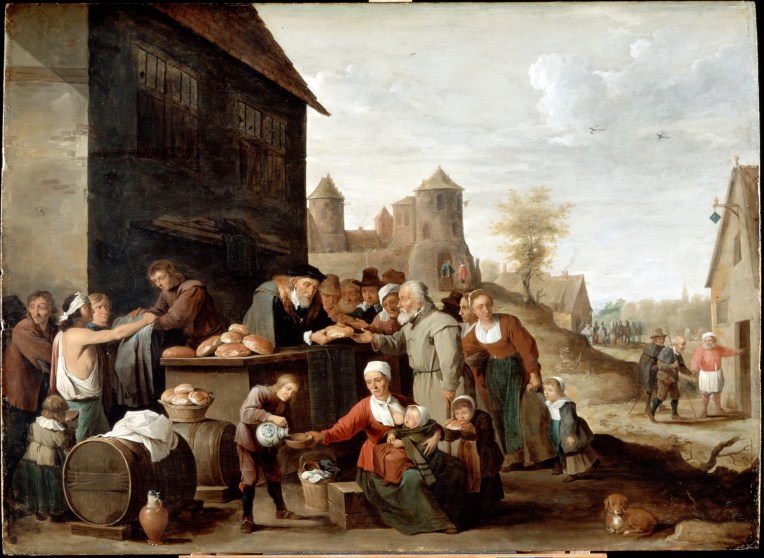
Practically, then, keep before your eyes the Church’s corporal and spiritual works of mercy.  If you have not yet memorized the seven spiritual works of mercy & the seven corporal works of mercy, then write them down longhand and post them on your refrigerator as a reminder.  Or if you’re adept at finding things on the computer, do a search for the spiritual and corporal works of mercy, print them out, and post them on your bathroom mirror.

Then make a resolve to focus especially on one particular work of mercy each week.  Even if you’re physically limited in what you can get out and do, perhaps because of advanced age or illness, you can certainly focus upon the spiritual works of mercy.  Yet if you are able also to carry out the corporal works of mercy, sacrifice your time and energy to do so.  In the Second Reading, St. James gives us an example, exhorting the faithful “to care for orphans and widows in their affliction”.

Jesus calls each of you to live an integrated life of faith.  Strengthened by God’s grace, Jesus calls you to live in Him, and to allow Him to live in you.  Jesus calls you to profess your faith in God with your hearts, with your lips, and with your hands.  Christianity is not some self-improvement program, but instead a way of giving up your life—sacrificing your life—so that others may live in Christ, all for the glory of God.


[1] John 1:1,14.

[2] Mark 4:1-9.  See also Matthew 13:1-9 and Luke 8:4-8.

[3] James 2:17.
The_Seven_Corporal_Works_of_Mercy - Teniers,_David_the_younger