Saturday of the 20th Week in Ordinary Time [II]

Saturday of the Twentieth Week in Ordinary Time [II]
Ezekiel 43:1-7  +  Matthew 23:1-12
August 25, 2018

“… you have but one Father in Heaven.”

Today’s Gospel passage contains a verse that some Christians quote to “prove” that one of Catholics’ most common practices is “unbiblical”.  Jesus declares, “Call no one on earth your father; you have but one Father in heaven.”  These words of Jesus would seem to disqualify the Catholic practice of addressing a priest as “Father”, as well as referring to the Pope as the “Holy Father”.

Those who make this argument might be taken aback, then, if it were pointed out to them how many passages from Saint Paul’s letters show the Apostle referring to himself as a spiritual father.  For example, Paul explains how the Corinthians have one father.  He squarely preaches to them, “You might have thousands of guardians in Christ, but not more than one father […] it was I who begot you in Christ Jesus…” [1 Cor 4:15].  It’s hard to imagine—if you were to interpret Holy Scripture in a literalistic sense—any words that more directly contradict Jesus’ command to “call no man on earth your father” than what St. Paul says of himself:  “You might have thousands of guardians in Christ, but not more than one father […] it was I who begot you in Christ Jesus….”

What are we to make of this seeming contradiction?  St. Paul’s following words only seem to heighten the contradiction against Jesus’ command.  St. Paul commands those listening to him:  “Be imitators of me, as I am of Christ” [1 Cor 4:16].  Why doesn’t St. Paul just say instead, “Be imitators of Christ”?  Some Christians will argue over and over again that the Catholic priesthood is a corruption of the Word of God because it puts a middle-man—a mediator—between Christ and the individual believer.  They will say instead that the individual Christian can go straight to Christ, without needing men in between.  (Of course they’ll turn a blind eye to the plain fact that the act of preaching—which is so prominent in Protestant denominations—is an act of a man mediating the Word of God to his listeners.)

It’s here that the teachings of Saint Paul—found, of course, in the Holy Bible—lead us deeper into the mystery of the Christian Faith.  St. Paul’s words don’t contradict Jesus’ command to call no man on earth your father:  St. Paul’s words deepen the revelation of Jesus.  Christian fathers, whether in the home or in the sanctuary, whether through the Sacrament of Marriage or through the Sacrament of Holy Orders, are called to say—by their example if not by their words—what St. Paul proclaims here:  “Be imitators of me, as I am of Christ.”  Christian fathers are called to lead their children each day and each week deeper into the life of Christ.
St. Bartholomew, Apostle

St. Bartholomew, Apostle
Revelation 21:9-14  +  John 1:45-51
August 24, 2018

“Come and see.”

When Philip points out Jesus as the promised Messiah, what does Nathaniel—also known as Bartholomew—say?  We can almost see Nathaniel shrugging his shoulders as he says, “Can anything good come from Nazareth?”  In this one sentence, he insults both Jesus and Jesus’ hometown.  Clearly, he does not have faith at this point.

But we see that Nathaniel is like Peter:  a slow learner, but someone who, once he realizes what’s going on, is completely “in”.  When Nathaniel hears Jesus call him, he realizes who Jesus is, and confesses this truth, declaring:  “Teacher, you are the Son of God; you are the king of Israel.”  So if any of us are slow to learn, we should remember that Jesus does not give up on us.  Jesus will still call each of us to live out his vocation each day, and give him whatever is needed to carry it out.

Yet we should also note something else in this “vocation story”:  that is, the role of Philip.  When God calls a young man to be a priest, or a young woman to the consecrated life, He usually calls him or her through other people.  We need not only to encourage vocations:  we need also to encourage those “other people” like Philip to encourage vocations.

After all, Philip said just three words:  “Come and see.”  But if Philip had not said these three simple words, Nathaniel might never have met Jesus, and the Church would not have been built up by this holy apostle Bartholomew.  Little words can do a lot for God’s great glory.

Thursday of the 20th Week in Ordinary Time [II]

Thursday of the Twentieth Week in Ordinary Time [II]
Ezekiel 36:23-28  +  Matthew 22:1-14
August 23, 2018

“Many are invited, but few are chosen.”

What are we to make of the violence in this parable?  The violence flies in two directions.  The second is on the part of the king, who acts in retribution.  Jesus issues a warning to us here that His Father is not just some sort of teddy bear, but rather a Just Judge.  On a practical level, though, the first form of violence is more important for us to reflect on, for it challenges our own way of acting.

First, some who are invited to the feast carry out violence.  Some invited guests simply refuse to come:  “Some ignored the invitation and went away, one to his farm, another to his business.”  But the rest of those invited killed the messengers!  Who are these invited guests, and who are the messengers?

In terms of the first century, when Jesus walked the earth, these invited guests symbolize those to whom Jesus was originally speaking.  The evangelist tells us that these are “the chief priests and elders of the people”.  But the evangelist recorded this parable in his Gospel account because it has perennial meaning.  This parable has been proclaimed in churches in every century since Jesus walked the earth.  The parable’s invited guests symbolize all of mankind who have heard God’s desire that “all peoples” and “all nations” enter into the wedding feast of Heaven.  We need, for our own sake, to understand the parable’s invited guests as ourselves:  you and I!

If we remember not only that God is inviting us into Heaven, but that confessing our sins to the Lamb who was slain is the ticket into the banquet, then we can more easily identify with the ungrateful invited guests.  “Some ignored the invitation and went away, one to his farm, another to his business.”  These persons have no need for either the ticket or the feast.  They have their own lives, and they are their own masters.

But then there are the others who had been invited.  They “laid hold of [the king’s] servants, mistreated them, and killed them.”  This violence forces the question:  who are these servants, and how can we understand the violence done to them?  Those who bring the Lord’s invitation to conversion may be other persons:  for example, a spouse, a parent, a priest, an employer, a neighbor, a grandparent, or a friend.  Unfortunately, we want spouses who compliment us, priests who tickle our ears from the pulpit, and friends who will tell us about the faults of others, rather than about our own.

The Queenship of the Blessed Virgin Mary

The Queenship of the Blessed Virgin Mary
Ezekiel 34:1-11  +  Matthew 20:1-16
August 22, 2018

“…the last will be first, and the first will be last.”

Jesus’ parable teaches us who we are to live for, and how we may serve them.

This parable, of course, is not about economics, but about merciful love.  When the landowner rhetorically asks, “am I not free to do as I wish with my own money?”, we understand that Jesus is, so to speak, putting words in the mouth of God the Father.  When faced with us human sinners, God the Father asks, “am I not free to do as I wish with my own merciful love?”

You and I gripe and complain like the laborers in this parable.  We cannot understand why others should receive blessings when they don’t deserve them.  We notice, in fact, not only that “the Lord makes His sun to shine on the evil and the good.”   God actually shows mercy to those who do not deserve it.  This gets to us because it seems unjust.

When we find ourselves torn between what seems just and what God chooses to offer to sinners, we need to reflect again on the answer that the Father gave us when He sent His eternal Son to become flesh and blood, so as to offer that flesh and blood on Calvary and through the Holy Sacrifice of the Mass.  Praying while gazing at a crucifix can help us reflect on the Cross as binding together the love of God and the love of neighbor.  In the light of this Cross, God asks us to prefer His form of mercy to our own sense of justice.

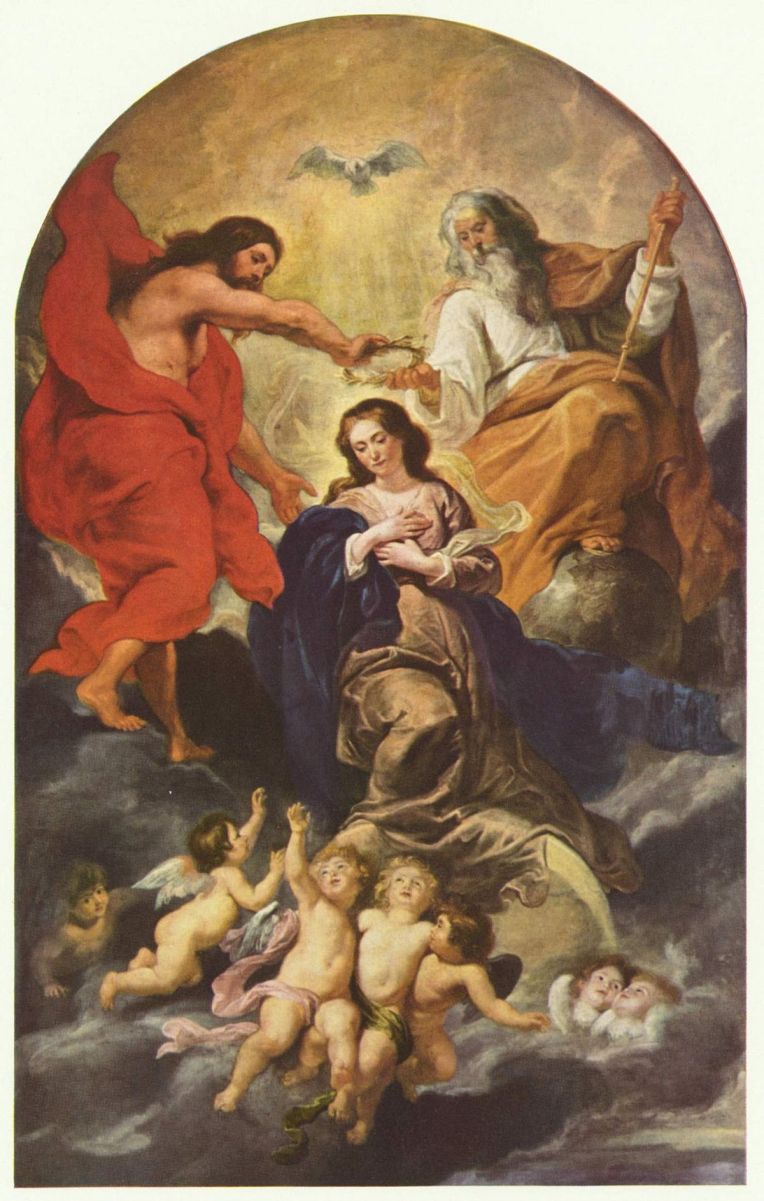
Coronation of Mary - Rubens

Pope St. Pius X

St. Pius X, Pope
Ezekiel 28:1-10  +  Matthew 19:23-30
August 21, 2018

“What will there be for us?”

Peter often comes across as a less than stellar candidate for the college of apostles, much less the leader of the apostles.  Consider that after Jesus has declared that salvation is impossible for man to accomplish, but that “for God all things are possible”, what does Peter reply?  He replies, “We have given up everything and followed you.  What will there be for us?”  Obviously Peter is not embarrassed by his self-interest.  We might admire his honesty in expressing himself, even if he himself isn’t so admirable on this occasion.  Can you imagine a brand new postulant arriving at the convent and asking where she can find the hot tub and the coffee bar?

But Jesus answers Peter’s question with a forbearance that might leave us scratching our heads.  Perhaps we need to reflect on whether, and how, Jesus is acting pedagogically here.  Jesus offers Peter an impressive response, assuring us that great gifts are in store in Heaven for those who are saved by God.

But this begs the question:  how does God save us?  For man it is impossible to save himself, but for God it is possible to save man.  But how does God save man?  This question seems to pass over Peter’s head, and perhaps at times over ours as well.  The answer, simply, is the Way of the Cross.  Peter in time will walk there.  God invites you to do so today.

St. Bernard, Abbot & Doctor of the Church

St. Bernard, Abbot & Doctor of the Church
Ezekiel 24:15-24  +  Matthew 19:16-22
August 20, 2018

“Teacher, what good must I do to gain eternal life?”

The young man in today’s Gospel passage knows that something more is needed.  He’s very confident that he has observed the commandments, but knows that he still lacks something for him to gain eternal life.  Jesus’ response aims for Heaven:  “to be perfect”, the young man must sell what he has in order to give to the poor, and then he must follow Jesus.

It would not be accurate to take today’s passage as a proof that every Christian must abandon all of his or her possessions.  Jesus was speaking on this occasion to an individual.  Individual members of the Body of Christ have different vocations, and are called in different ways.  Individual calls include individual ways of using or giving away material goods.

What every Christian vocation does have in common with every other is to seek “to be perfect”.  In fact, Jesus commands us elsewhere to be perfect as our heavenly Father is perfect.  That might seem an impossibly lofty goal, were we not to understand the meaning of the word “perfect”.  From the Latin, it could be loosely translated as “to become what one is”, or in other words, “to become what one is meant to be”.  God is perfectly God without any trouble.  We humans, on the other hand, have lots of trouble.  God “designed” each human person, and calls each human person, to spend himself in love for others, and above all, for God Himself as the ineffable Other.  However God may ask you to accomplish this, give thanks for His call.

The Twentieth Sunday in Ordinary Time [B]

The Twentieth Sunday in Ordinary Time [B]
Proverbs 9:1-6  +  Ephesians 5:15-20  +  John 6:51-58

“For my Flesh is true food, and my Blood is true drink.”

Jesus has told the Jewish crowd, “I am the bread of life.”  But they ignore his words.  For our own part, we need to ask ourselves what we are ignorant of.  If we’re willing to ask that question, and listen to the answer, we may grow in wisdom.  Here’s one of the differences between a computer and a human person created in the Image of God:  a computer doesn’t know what it doesn’t know.  A computer only knows what it’s programmed to know, and no more.  But a human person can desire to know more, and can search outside himself for the answers, or at least for someone to help him find the answers.

It’s a fairly common experience for us to be frustrated by a situation, and to have no idea what to do next.  For example, we may feel ignorant before a jigsaw puzzle, or before a report that’s due next week, or even before a person whom we do not understand.  So we ask ourselves, “what am I to do next?”  The missing piece to the puzzle is often right in front of our eyes, and we cannot see it.  We need someone else to stand before us and point out the missing piece to us with His finger.  We need a teacher.

Jesus, like any good teacher, responds to their ignorance with compassion.  He takes the initiative, because they don’t even know what they’re ignorant of.  The Jews quarreled among themselves, saying, “How can he give us his flesh to eat?”  Jesus replies, not by saying that “eating his flesh” is just a figure of speech.  Instead, Jesus replies by saying, “if you do not eat the Flesh of the Son of Man and drink His Blood, you have no life in you. …For my Flesh is Real Food and my Blood is Real Drink.”

Jesus is speaking about the flesh and blood that he is going to offer on the Cross on Good Friday.  Jesus, at this point in the gospel, cannot offer this real bread and drink just yet.  It’s not yet His Hour.  He’s trying to prepare them.  He does not say, “The bread I am giving you is my flesh.”  Instead, He says, “The bread I will give is my flesh, for the life of the world.”

Jesus gave His Flesh and Blood for us when He died on the Cross on Good Friday.  But He established the Sacrifice of the Mass on the night before He died, on Holy Thursday evening.  In that Upper Room, with His apostles, He prepared a banquet for those in the future who would be willing to admit that they are nothing without Him.  This banquet is for those of us who are without understanding, but who at least know what we don’t know.  We know we must be like Christ to truly live.  But we cannot imitate Christ through sheer will-power.  We must be nourished by God Himself.  Only when He dwells within you can you live your life as He led His.

This is why we need to prepare ourselves to receive the Holy Eucharist worthily.  This is why we need to be generous in spending time with Jesus in Eucharistic Adoration.  This is why we need to turn to Jesus for the answer to life’s most important question, and not to technology, or politics, or the entertainment industry.

In that Upper Room at His Last Supper, “on the night He was betrayed, he took bread and gave” [God the Father] thanks and praiseJesus broke the bread,” and offered it to His disciples just as He offers it to you and me every day in the Holy Sacrifice of the Mass.  Every day, He says standing plainly before us:  “Take this, all of you, and eat it.  This is my Body which will be given up for you.”  The question before us when we come to Jesus in the Holy Eucharist is, “do we know enough to know how hungry we are?”  Or do we think that we are in control of our lives?

The TWENTIEth Sunday in Ordinary Time [B]

The Twentieth Sunday in Ordinary Time [B]
Proverbs 9:1-6  +  Ephesians 5:15-20  +  John 6:51-58

“For my Flesh is true food, and my Blood is true drink.”

No would deny that being smart is a good thing.  But how far can it get you in life?  More importantly, how far can it get you in death?

King Solomon, in our First Reading from the Book of Proverbs, wants to focus our attention on wisdom.  King Solomon records divine Wisdom as calling out to mankind:  “Let whoever is simple turn in here”; to the one who lacks understanding, she says, “Come, eat of my food, and drink of the wine I have mixed!”  Unfortunately, as children of Adam and Eve, our tendency is to think that we’re in control of everything in our lives:  that we understand everything.  If God’s Wisdom were to take flesh, and appear in our homes, offering this same invitation to the simple, would we consider ourselves invited?  Or are we not among the simple?  Do we not need help from God’s divine Wisdom?

In the Second Reading, Saint Paul urges us not to continue in our ignorance.  He urges us to make “the most of the opportunity” of the present moment.  He urges us to be “filled with the Spirit”, to give “thanks to God the Father always and for everything in the name of our Lord Jesus Christ”.  We need to give thanks even for the opportunities in our lives not to be in control, and even for the opportunity to die.  We need to die, so that Christ can live in us.  Or to put today’s scriptures in another way, the question is:  are you wise enough to seize the opportunity to die?                                                            

That is the opportunity that the Wisdom of God made Flesh offers the crowds in today’s Gospel passage.  This Sunday is the fourth of five Sundays this summer when our Gospel Reading comes from John chapter 6.  This entire chapter is one long series of narratives in which St. John the Evangelist shows Jesus leading others deeper and deeper into the mystery of the Eucharist:  the mystery of His Real Presence as the “Bread of Life”.

Jesus has told the Jewish crowd, “I am the bread of life.”  But they ignore his words.  For our own part, we need to ask ourselves what we are ignorant of.  If we’re willing to ask that question, and listen to the answer, we may grow in wisdom.  Here’s one of the differences between a computer and a human person created in the Image of God:  a computer doesn’t know what it doesn’t know.  A computer only knows what it’s programmed to know, and no more.  But a human person can desire to know more, and can search outside himself for the answers, or at least for someone to help him find the answers.

It’s a fairly common experience for us to be frustrated by a situation, and to have no idea what to do next.  For example, we may feel ignorant before a jigsaw puzzle, or before a report that’s due next week, or even before a person whom we do not understand.  So we ask ourselves, “what am I to do next?”  The missing piece to the puzzle is often right in front of our eyes, and we cannot see it.  We need someone else to stand before us and point out the missing piece to us with His finger.  We need a teacher.

Jesus, like any good teacher, responds to their ignorance with compassion.  He takes the initiative, because they don’t even know what they’re ignorant of.  The Jews quarreled among themselves, saying, “How can he give us his flesh to eat?”  Jesus replies, not by saying that “eating his flesh” is just a figure of speech.  Instead, Jesus replies by saying, “if you do not eat the Flesh of the Son of Man and drink His Blood, you have no life in you. …For my Flesh is Real Food and my Blood is Real Drink.”

Jesus is speaking about the flesh and blood that he is going to offer on the Cross on Good Friday.  Jesus, at this point in the gospel, cannot offer this real bread and drink just yet.  It’s not yet His Hour.  He’s trying to prepare them.  He does not say, “The bread I am giving you is my flesh.”  Instead, He says, “The bread I will give is my flesh, for the life of the world.”

Jesus gave His Flesh and Blood for us when He died on the Cross on Good Friday.  But He established the Sacrifice of the Mass on the night before He died, on Holy Thursday evening.  In that Upper Room, with His apostles, He prepared a banquet for those in the future who would be willing to admit that they are nothing without Him.  This banquet is for those of us who are without understanding, but who at least know what we don’t know.  We know we must be like Christ to truly live.  But we cannot imitate Christ through sheer will-power.  We must be nourished by God Himself.  Only when He dwells within you can you live your life as He led His.

This is why we need to prepare ourselves to receive the Holy Eucharist worthily.  This is why we need to be generous in spending time with Jesus in Eucharistic Adoration.  This is why we need to turn to Jesus for the answer to life’s most important question, and not to technology, or politics, or the entertainment industry.

In that Upper Room at His Last Supper, “on the night He was betrayed, he took bread and gave” [God the Father] thanks and praiseJesus broke the bread,” and offered it to His disciples just as He offers it to you and me every day in the Holy Sacrifice of the Mass.  Every day, He says standing plainly before us:  “Take this, all of you, and eat it.  This is my Body which will be given up for you.”  The question before us when we come to Jesus in the Holy Eucharist is, “do we know enough to know how hungry we are?”  Or do we think that we are in control of our lives?

Saturday of the 19th Week in Ordinary Time [II]

Saturday of the Nineteenth Week in Ordinary Time [II]
Ezekiel 18:1-10,13,30-32  +  Matthew 19:13-15
August 18, 2018

“Let the children come to me, and do not prevent them….”

Our spiritual need for humility is like our body’s need for water:  it is foundational in an on-going manner; that is, in a manner that we constantly have to attend to.  It’s not like the foundation of a house that you pour once and then don’t (hopefully) have to attend to afterwards.

Some people think that humility is only for children.  This sort of thinking says, “Of course you should be humble when you’re small.  You should also be humble when you’re applying for a job, and when you’re going to confession, and when you’re at the bank applying for a loan.  But once you’re older, and you’ve made something of your life, and have money in the bank, and people who work for you… well, then, the time for humility is past.  At this point, you should take pride in yourself.”

But Jesus says just the opposite.  Jesus, who is divine, and the only-begotten Son of God, declared at the Annunciation:  “I am willing to become even less than a tiny baby.  I will become a single-celled human being inside the womb of this 14-year-old girl, in order to grow up and die to take away the sins of all mankind.”

We can reflect on the example of the Annunciation as a concrete example of Jesus’ counsel today.  Both Mary and Jesus in the scene of the Annunciation show us to whom “the Kingdom of Heaven belongs”.  Both Mary and Jesus demonstrate humility, but from opposite ends of a spectrum.  Mary—a poor, weak girl—submits her self to God the Father, accepting from Him a vocation that she cannot possibly at that point understand.

Jesus—God’s own divine Son—submits his self to God the Father, accepting from Him a vocation that we cannot understand.  Our Blessed Mother and Our Lord show us that humility is needed at every step of our lives:  from the beginning of our life on this earth, to the end of our life in Heaven.  We never outgrow the need for humility.